Namibia is one of the safest and easiest countries in Africa for independent travellers: stable, peaceful, with good infrastructure, English widely spoken and a long tradition of self-drive tourism. The realistic risks are opportunistic crime in towns (especially Windhoek), road accidents on long gravel roads, and, in the north and north-east, malaria, which surged in 2025 and 2026. With sensible habits, all three are manageable.
This guide covers crime and scams, roads, wildlife, health and emergency numbers for the whole country. If you are spending time on the coast, read our dedicated Swakopmund safety guide too. Travel advice changes, so check your own government’s advisory before you go.
How safe is Namibia overall?#
Namibia has held peaceful elections since independence in 1990, and in March 2025 Netumbo Nandi-Ndaitwah became the country’s first female president after a smooth transfer of power. There is no recent history of terrorism, though Western governments say attacks cannot be ruled out anywhere. The US government rated Namibia Level 2 (“Exercise increased caution”) in 2026 because of crime, and both the US and UK advisories say most crime against visitors is opportunistic: theft from vehicles, bag snatching, pickpocketing and muggings.
Put simply: violent crime against tourists is uncommon but not unknown, petty theft is the thing to plan for, and the road is statistically your biggest risk.
Crime: where and how to stay safe#
Windhoek#
The capital is where visitors are most likely to run into trouble. The UK government warns that muggings targeting tourists happen at any time of day and can be violent, and that gangs sometimes try to get into cars at busy intersections.
- Don’t walk around after dark, even short distances in the centre. Take a taxi booked by your accommodation or restaurant.
- Don’t hail taxis on the street. Shared town taxis are cheap but not suited to visitors with luggage.
- Keep doors locked and windows up in traffic, and keep bags off the seats and in the footwell or boot.
- Don’t wander into townships, including Katutura, without someone local. A guided tour by day is the best way to visit.
- Keep valuables in the hotel safe and carry a copy of your passport.
Theft from vehicles#
This is the most common crime affecting self-drivers anywhere in Namibia: in Windhoek, Swakopmund, Walvis Bay, Rundu, at fuel stations and at viewpoints.
- Never leave anything visible in a parked car, and don’t leave the car unattended at fuel stations: the UK government specifically mentions theft at service stations.
- Pack the car before you arrive somewhere, not in the car park.
- Use secure parking at night and tip the informal car guards (approx. N$5–N$10) in town car parks.
- On remote roads, be wary of anyone flagging you down. Police on the coast have warned of criminals faking breakdowns. If something feels off, drive on to the next town or police station.
Scams and hassles#
- Card skimming has occurred at some hotels and lodges. Keep your card in sight.
- “Helpers” at ATMs: never accept help, and use machines inside banks or malls.
- Fake visa websites: apply only on the official government portal; our Namibia visa guide explains how.
- Street sellers who carve your name on a makalani nut and then demand payment. Say “no thanks” early.
- Unlicensed tour sellers: book through your accommodation or established operators.
Road safety: the biggest risk#
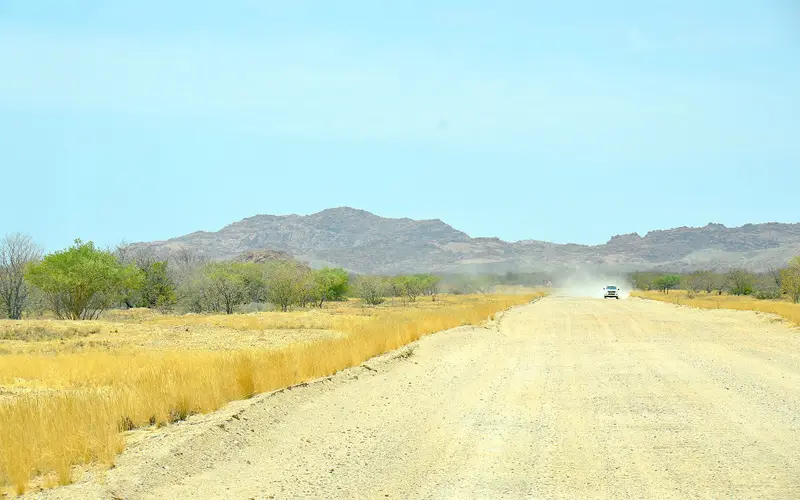
Namibia has a road network of roughly 48,000 km, the large majority of it gravel, and long distances between towns. Accidents involving tourists are usually single-vehicle crashes: a car rolls after the driver loses control on loose gravel, often at speed, on a bend or while overcorrecting.
Gravel roads#
- Drive at about 80 km/h on gravel, even where the legal limit is 100 km/h, and slower on corrugations, bends, crests and dips.
- Brake and steer gently. Sudden movements on gravel cause rollovers.
- Headlights on in dust, and back off when a vehicle passes so stones don’t crack your windscreen.
- Watch the edges: loose gravel builds up at the side of the road (“windrows”) and can pull a car sideways.
- Tyres: check pressures at each fuel stop, carry two spares on long routes and know how to change one.
- After rain, gravel roads deteriorate and dry riverbeds can flood. Never drive into flowing water. The UK government advises carrying two spare tyres, plenty of water and checking road conditions in the January–April rainy season.
Night driving and animals#
Don’t drive outside towns after dark. Kudu, oryx, warthog, cattle, goats and donkeys wander onto the roads, many vehicles have poor lights, and pedestrians walk along roadsides. Many rental contracts ban night driving. Plan your days so you arrive before sunset, which can be as early as about 18:15 in June.
Fatigue and distance#
Distances are huge and the scenery hypnotic. Swap drivers every two hours, avoid driving long-haul on the day you land, and don’t plan more than about 400–450 km a day on gravel. Our Namibia road trip itinerary uses realistic daily distances.
Other road rules#
- Drive on the left. Speed limits are 60 km/h in towns, 120 km/h on open tar and 100 km/h on gravel unless signed.
- Trucks dominate the B1 and B2. Overtake only with a long, clear view.
- Police roadblocks are common. Have your licence, passport copy and rental papers ready.
- Drink-driving is a serious problem on weekends and holidays. Be extra careful in the evenings.
- Insurance: many basic rental policies exclude single-vehicle accidents, tyres and windscreens. Read our car rental guide before you sign.
Fuel and remoteness#
Fuel stations can be 200 km or more apart, and some NWR rest camps (including inside Etosha) have had no fuel for long periods since 2025. Fill up whenever you pass a town, carry cash for remote pumps (see our Namibia currency guide), and carry at least 5 litres of water per person. Mobile signal disappears quickly outside towns, so download offline maps and tell someone your route.
Wildlife safety#
Namibia’s wildlife is a highlight, and incidents are rare when visitors follow the rules.
- In Etosha and other parks, stay in your vehicle except at designated toilets and rest camps. Lions and other predators may be close to the road.
- Elephants roam Damaraland and the north-west outside parks, including near campsites. Give them a wide berth, never drive between a mother and calf, and back off if an elephant flares its ears or approaches.
- Rivers in the north-east (Zambezi, Kavango, Kwando, Chobe) have hippos and crocodiles. Don’t swim, don’t walk along riverbanks at dusk, and follow lodge advice.
- Snakes and scorpions are present but rarely seen. Wear closed shoes at night, use a torch, shake out shoes and don’t put your hands under rocks.
- Desert-adapted lions live in parts of Kunene; camp only at official sites and keep food inside the vehicle.
- Cheetahs and other animals at “farms”: only visit reputable sanctuaries and never pet wild animals.
Health risks#
Malaria#
- Malaria-free: the coast (Swakopmund, Walvis Bay, Lüderitz), Windhoek, Sossusvlei, the south and most of the central highlands.
- Seasonal risk: northern regions including the Etosha area, Kunene, and the north-central regions.
- Highest risk: Zambezi (Caprivi), Kavango East and Kavango West.
In 2026 Namibia saw a major malaria surge linked to unusually heavy rains: WHO reported more than 52,000 cases and 61 deaths in the first 14 weeks of the year, with Katima Mulilo, Rundu, Andara, Nkurenkuru, Nyangana and Outapi among the hardest-hit districts. The risk peaks from about December to late April. If you are going north of Etosha or to the Zambezi region, see a travel clinic about antimalarial tablets, use repellent and sleep under a net or in screened rooms. Any fever during or after a trip north needs a malaria test straight away.
Sun, heat and dehydration#
The sun is fierce, especially in the desert, where summer temperatures exceed 40°C. Carry plenty of water, start dune walks such as Deadvlei at sunrise, wear a hat and sunscreen, and watch for signs of heat exhaustion.
Medical care#
Private hospitals and clinics in Windhoek, Swakopmund, Walvis Bay, Otjiwarongo and Oshakati offer good care but are expensive. Elsewhere, facilities are basic and distances are long, so travel insurance with medical evacuation cover is essential. Private ambulance and evacuation services operate, and many lodges are on their call lists.
Other health tips#
- Make sure routine vaccinations are up to date; travel clinics often recommend hepatitis A and typhoid, and sometimes rabies for long rural trips.
- A yellow fever certificate is required if you arrive from, or have transited through, a country with yellow fever risk.
- Tap water in the main towns is treated. At remote sites, ask or use bottled water.
Advice for specific travellers#
- Solo travellers: Namibia is very popular with solo travellers. If you won’t be driving, guided small-group trips and shuttles make it easy; our Windhoek to Swakopmund guide covers the shuttles.
- Women: most women find Namibia comfortable. Avoid walking alone at night, use trusted taxis and keep an eye on your drink.
- LGBTQ+ travellers: the legal position has been in flux since a 2024 High Court ruling against colonial-era laws, and attitudes remain conservative, especially in rural areas. Discretion with public displays of affection is sensible.
- Families: Namibia is excellent for children, but bring the correct documents for minors (see our visa guide) and plan short driving days.
Emergency numbers#
| Service | Number |
|---|---|
| Police (national emergency) | 10111 |
| Emergency from a mobile phone | 112 |
Save your rental company’s 24-hour breakdown number, your accommodation’s number and your insurer’s emergency line before you set off. Ask your lodge for the local ambulance and police station numbers when you arrive. If you are robbed, report it to the police and get a case number for insurance.
Quick safety checklist#
- Nothing visible in the car, ever, and never leave it unattended at fuel stops.
- No walking after dark in Windhoek; use booked taxis.
- 80 km/h on gravel, no night driving outside towns, two spare tyres.
- Fuel up and draw cash in every town; carry 5 litres of water per person.
- Stay in your vehicle in Etosha; keep well away from elephants and rivers in the north-east.
- Antimalarials on medical advice if heading to the far north.
- Insurance that covers medical evacuation and adventure activities.
Follow these and Namibia is a wonderfully rewarding place to travel. On the coast, also read is Swakopmund safe, and plan your route with the best time to visit Namibia.
Photo gallery
Frequently asked questions
Is Namibia safe for tourists?
Yes. Namibia is politically stable, peaceful and used to independent travellers, and most visits are trouble-free. The realistic risks are opportunistic crime in towns, especially Windhoek, and road accidents on long gravel roads, which injure far more visitors than crime does.
Is Windhoek safe?
Windhoek is generally fine by day with sensible precautions, but muggings and theft from cars do happen, sometimes violently. Don't walk around after dark, use taxis booked by your accommodation, keep valuables out of sight and never leave anything in a parked car.
Is it safe to self-drive in Namibia?
Yes, if you drive carefully. Keep to about 80 km/h on gravel, never drive at night outside towns, take breaks against fatigue and know how to change a tyre. Most serious tourist accidents are single-vehicle rollovers caused by speed on gravel.
Do I need malaria tablets for Namibia?
Not for the coast, Windhoek, Sossusvlei or the south. The north and north-east, especially the Zambezi and Kavango regions, have malaria, and 2026 saw a major surge. Etosha and the far north also carry a seasonal risk. Ask a travel clinic about tablets if you are heading north, particularly from about December to May.
Is Namibia safe for solo female travellers?
Many women travel Namibia alone or in pairs without problems. Use the same precautions as in any city, avoid walking alone at night, book taxis through your accommodation and stay in well-reviewed places. Joining small-group tours is an easy way to see the remote areas safely.
Is the tap water safe to drink in Namibia?
In the main towns, including Windhoek and Swakopmund, tap water is treated and generally considered safe, though some people prefer bottled water for the taste. At remote campsites and farms, ask first and carry plenty of bottled water.