You don’t need a car to enjoy Swakopmund itself: the town is walkable and nearly every tour includes a pickup from your accommodation. But if you want to explore the coast, drive to Spitzkoppe or continue to Sossusvlei and Etosha, renting a car is the most flexible and, for a group, often the cheapest way to see Namibia. For most coastal trips a normal 2WD car is enough; a 4x4 earns its cost only on longer gravel routes.
This guide explains where to rent, approximate 2026 prices, the insurance traps that catch visitors, and how to drive Namibia’s roads safely. Rental rates change by season and company, so use the figures here as a guide and always get a written quote.
Do you need a car in Swakopmund?#
You can skip the car if…#
- You’re staying in central Swakopmund and doing organised activities: sandboarding, quad biking, the Living Desert tour and the Sandwich Harbour 4x4 tour all pick you up.
- You arrive by shuttle or bus from Windhoek (see how to get to Swakopmund).
- You’re travelling solo on a tight budget. Taxis and tour transfers will cost less than a week of car hire.
A car makes sense if…#
- You want to do independent day trips: the Moon Landscape and Welwitschia Drive, Spitzkoppe, Cape Cross and the Skeleton Coast.
- Swakopmund is one stop on a wider Namibia road trip.
- You’re a group of three or four; split four ways, a car is often cheaper than shuttles and tour transfers.
2WD or 4x4?#
| Route | Road surface | 2WD sedan OK? | Recommended vehicle |
|---|---|---|---|
| Windhoek to Swakopmund (B1/B2) | Tar | Yes | Any car |
| Swakopmund to Walvis Bay, Dune 7 | Tar | Yes | Any car |
| Swakopmund to Henties Bay, Cape Cross | Salt road (C34) | Yes, in dry conditions | Any car; slow down when damp |
| Moon Landscape / Welwitschia Drive | Gravel | Usually, with care | High clearance helps |
| Spitzkoppe | Tar plus gravel | Usually | SUV or high clearance |
| Swakopmund to Sossusvlei via Solitaire | Gravel, passes | Possible but rough | SUV or 4x4 (no self-drive beyond the 2x4 car park since May 2026) |
| Damaraland, Kaokoveld, remote Skeleton Coast | Rough gravel, sand, river beds | No | 4x4 |
| Sandwich Harbour, dune driving | Deep sand, tides | No | Book a guided tour |
Our take: if your trip is Windhoek, Swakopmund and Walvis Bay with a couple of easy day trips, a compact car or small SUV is fine and much cheaper. If you are continuing to Sossusvlei and beyond on gravel for several days, pay for a high-clearance SUV or a 4x4 double cab: better tyres, more ground clearance and more stable handling on loose surfaces matter more than four-wheel drive itself.
Even a 4x4 no longer gets you all the way into Sossusvlei: since 1 May 2026, self-drive vehicles must stop at the 2x4 car park and visitors continue on the official shuttle. Details are in our Swakopmund to Sossusvlei guide.
Where to rent#
Walvis Bay Airport#
The most convenient pickup point for the coast. Avis, Budget, Hertz and Europcar (plus some smaller brands) have desks in the arrivals hall. Fleets here are smaller than in Windhoek, so book well ahead in July–October and December–January, and expect office hours to be shorter at weekends. Tell the company your flight number.
Swakopmund and Walvis Bay towns#
A few international brands and local firms have town branches or deliver to your hotel. One-day rentals for a day trip are possible but limited; ask your hostel or hotel, which can often arrange a car or recommend a trusted local operator.
Windhoek and Hosea Kutako Airport#
Windhoek has by far the biggest choice, including the international brands and established Namibian specialists in 4x4 and camping vehicles such as Asco Car Hire, Caprivi Car Hire and Namibia2Go. If you are touring the whole country, pick up in Windhoek and loop back; our Namibia road trip itinerary shows a typical loop, and the Windhoek to Swakopmund guide covers the first leg. After-hours pickups at the airport often carry an extra fee, while many Windhoek firms include a free airport pickup or drop-off, so ask.
Approximate rental prices (2026)#
| Vehicle | Example | Low season (approx.) | High season (approx.) |
|---|---|---|---|
| Compact 2WD | VW Polo Vivo, Toyota Starlet | N$600–N$800/day | N$800–N$1,000/day |
| Small SUV / crossover | Toyota Urban Cruiser, Renault Duster | N$800–N$1,100/day | N$1,000–N$1,400/day |
| 7-seat SUV | Toyota Fortuner | N$1,200–N$1,600/day | N$1,500–N$2,000/day |
| 4x4 double cab | Toyota Hilux | N$1,300–N$1,800/day | N$1,700–N$2,200/day |
| 4x4 camper with rooftop tent | Hilux or Land Cruiser with camping kit | N$1,800–N$2,400/day | N$2,200–N$2,800+/day |
These are approximate 2026 ranges with standard insurance and unlimited kilometres, for rentals of a week or so. Short rentals cost more per day, and long rentals of 14+ days often get a discount. High season generally means July to October and the December–January holidays.
Extras to budget for#
- Higher insurance cover / excess reduction: often the biggest extra, roughly N$150–N$500 per day depending on vehicle.
- Tyre and windscreen cover: strongly recommended for any gravel driving.
- Additional driver: usually a small one-off or daily fee.
- One-way fee: if you don’t return the car where you collected it.
- Cross-border letter of authority: a fixed fee per trip if you leave Namibia.
- Camping kit, fridge, GPS, child seats, satellite phone: priced per day.
- Contract fees and taxes: some quotes exclude these; ask for the total.
Insurance: read the small print#
Insurance is where most Namibia rental horror stories begin. Standard cover usually leaves you with an excess (the amount you pay if anything goes wrong) that can run into tens of thousands of Namibian dollars, and many policies exclude:
- tyres, windscreens and headlights (stone chips are almost inevitable on gravel)
- undercarriage damage from rocks or ruts
- water damage from crossing rivers or driving through seawater
- single-vehicle accidents such as rollovers, which are the most common serious accident type on gravel
- damage while driving at night outside towns, or off designated roads
- negligence, including speeding or driving under the influence
What to do:
- Ask for the excess amount and full list of exclusions in writing before you pay.
- Take the higher cover tier if you are driving any distance on gravel, and add tyre and windscreen cover.
- Consider “zero excess” cover if it is offered. It costs more per day but means no large deposit is blocked on your card and no argument over stone chips at drop-off.
- Check what your credit card or travel insurance covers; many policies exclude 4x4s or campers.
- Photograph and video the car (including tyres, windscreen, roof and spare) at pickup and drop-off.
- Keep the emergency number of the rental company saved on your phone, and buy a local SIM so you can actually call it.
Requirements for renting a car in Namibia#
- Driving licence: your valid national licence. If it is not in English or lacks a photo, you need an International Driving Permit (IDP) as well. An IDP is only valid together with the original licence, and police checkpoints may ask for both.
- Age: usually at least 21 to 23, often with a young-driver surcharge; some companies require 25 for 4x4 campers. Most also require you to have held your licence for at least one to two years.
- Credit card: in the main driver’s name, for the deposit. Debit cards are often not accepted. Deposits typically range from a few thousand Namibian dollars for a small car to N$15,000 or more for a 4x4 without extra cover.
- Passport: needed at pickup. Remember that since April 2025 many nationalities, including UK, US and most EU citizens, need a visa for Namibia (available on arrival or pre-approved online). Our Namibia visa guide explains the process; if you apply online, a rental confirmation is one of the documents you may be asked for.
Crossing borders with a rental car#
Most Namibian rental companies allow trips into South Africa and Botswana, and sometimes Eswatini and Lesotho, if you request it in advance. Expect to:
- give at least 48–72 hours’ notice
- pay for a letter of authority from the rental company
- carry the vehicle registration papers the company provides
- pay road or cross-border fees at the border posts
Angola is usually off limits, and Zambia and Zimbabwe may require extra paperwork and insurance. If you are entering Namibia in a car rented in South Africa, the rental company must authorise the trip, and Namibia charges a cross-border road fee at the border.
Driving tips for Namibia#
The basics#
- Drive on the left, overtake on the right. Most rental cars are manual; request an automatic early.
- Speed limits: 60 km/h in towns, 120 km/h on open tarred roads, 100 km/h on gravel unless signed lower.
- Seatbelts are compulsory, and using a hand-held phone while driving is illegal.
- Drink-driving limits are strictly enforced at roadblocks, especially on holiday weekends.
- Police roadblocks are routine. Slow down, be polite and have your licence and passport ready.
On gravel roads#
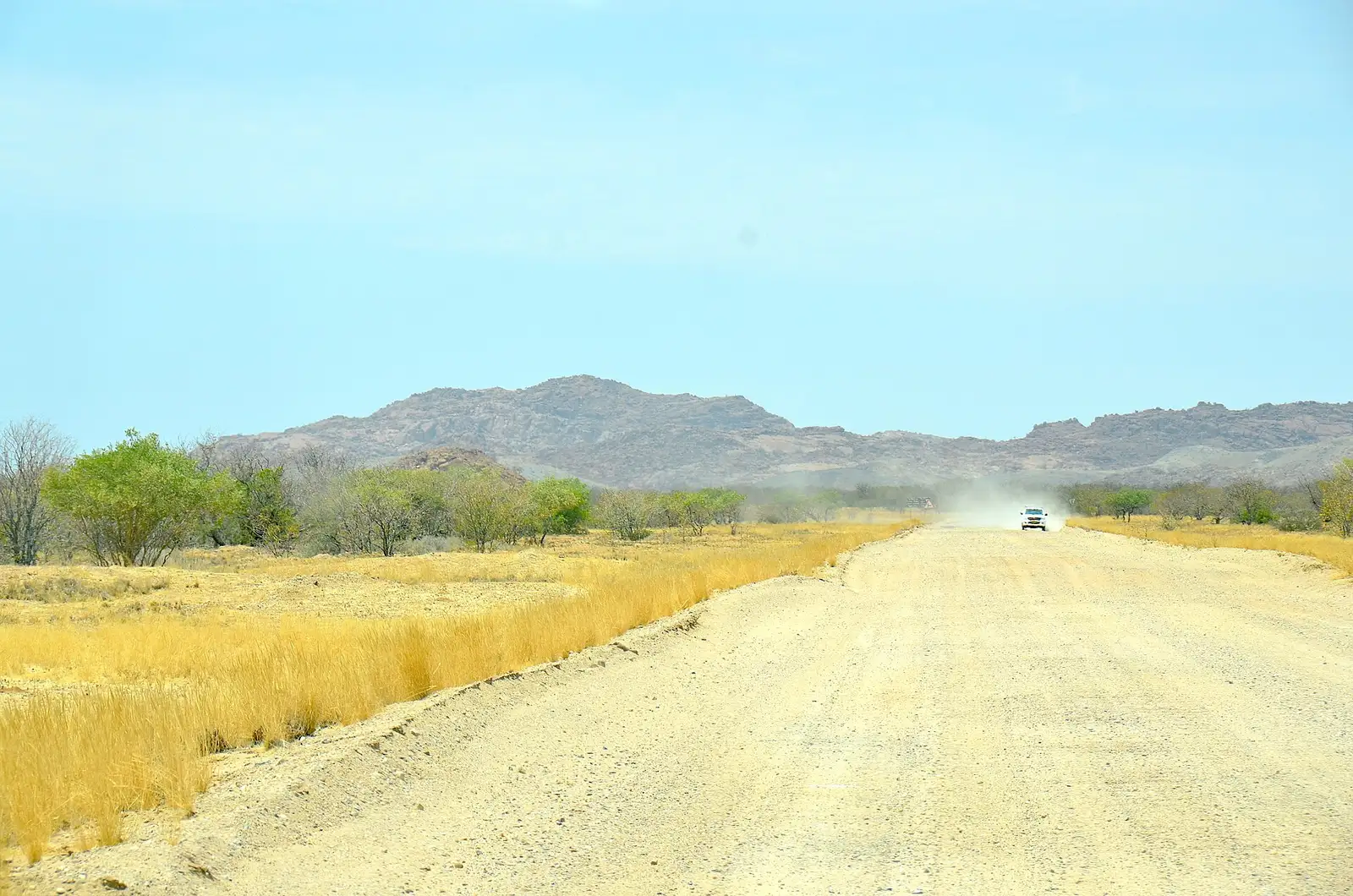
- Keep to 80 km/h at most, even where the legal limit is 100. Gravel surfaces change suddenly.
- Slow down early before bends, dips and crests; brake on straight sections, not in the turn.
- Don’t over-correct if the back slides. Ease off the accelerator and steer gently.
- Corrugations (“washboard”) shake the car; a steady moderate speed is safer than speeding up.
- Dust: when a vehicle approaches, slow down and keep left; you may lose visibility for several seconds.
- Ask the rental company for the correct tyre pressure for gravel and check the spare before you leave.
Wildlife, night driving and fuel#
- Avoid driving after dark outside towns. Kudu, oryx, livestock and donkeys are hard to see and collisions are often serious.
- On remote routes, top up whenever you pass fuel, even with three-quarters of a tank left. Distances between stations can exceed 150–200 km, and small rural stations occasionally run dry, more often of diesel than petrol. Swakopmund, Walvis Bay and Henties Bay all have fuel.
- Fuel prices are regulated nationally, set at Walvis Bay and reviewed monthly; the further inland, the slightly higher the price. In October 2026 petrol (95) was N$26.58 per litre and diesel N$27.86 (50 ppm) or N$27.96 (10 ppm) at Walvis Bay. Diesel rental cars run on 50 ppm unless the company tells you otherwise.
- Attendants fill the tank, and usually clean the windscreen and offer to check oil and tyres; a tip of N$10–N$20 is customary. Town stations take cards, but keep cash for small rural stations, where card machines are not always working.
Punctures and tyres#
Punctures are the most common breakdown on gravel, usually from sharp stones on corrugated stretches or from driving too fast on tyres pumped up for tar.
- Before you leave: check that the spare (or both spares, on most 4x4s) is inflated and that the jack, wheel spanner and any tyre plug kit and compressor are in the car. Ask for a demonstration if you have never used them.
- On the road: if a tyre goes down, slow gradually and stop well off the road. Driving even a short distance on a flat destroys the tyre and can damage the rim.
- After a puncture: get the damaged tyre repaired or replaced at the next town. A second puncture without a usable spare is how a minor problem becomes a long wait. Swakopmund and Walvis Bay have several tyre shops.
- Reinflate after any section where you lowered pressure, before you return to tar.
Parking in Swakopmund#
Car break-ins are the most common crime affecting visitors on the coast. Park in guarded or well-lit spots, use your accommodation’s secure parking, and never leave bags, phones or cameras visible. More in our Swakopmund safety guide.
Sample costs: one week on the coast and Sossusvlei#
Four friends renting a 4x4 double cab in Windhoek for 7 days, driving to Swakopmund, then via Solitaire to Sossusvlei and back to Windhoek (around 1,300 km):
| Item | Approx. cost (2026) |
|---|---|
| 4x4 double cab, 7 days at approx. N$1,600/day | N$11,200 |
| Upgraded insurance and tyre/windscreen cover | N$2,000–N$3,000 |
| Additional driver | N$200–N$500 |
| Fuel (about 160 litres of diesel) | N$4,500–N$5,000 |
| Total | approx. N$18,000–N$19,700 |
| Per person (4 people) | approx. N$4,500–N$4,900 (about US$250–US$275) |
A compact 2WD for a coast-only week would cost roughly half that. For more budget planning, see our Swakopmund budget travel guide.
Booking checklist#
- Compare an international brand and a Namibian specialist for the same dates.
- Confirm unlimited kilometres, insurance excess and exclusions, and the total price including fees.
- Check pickup hours, especially for weekend or late arrivals at Walvis Bay.
- Ask whether gravel roads and the routes you plan are permitted.
- Request cross-border permission in advance if needed.
- Inspect the vehicle, both spare tyres (on 4x4s), the jack and the tools before driving away.
- Return the car with a full tank (most policies are full-to-full) and get the return inspection signed.
Alternatives to renting#
- Guided tours and packages: if you’d rather not drive, see our Swakopmund tours and packages guide.
- Shuttles: shared shuttles link Windhoek, Swakopmund and Walvis Bay daily.
- Taxis: fine for getting around town; ask your accommodation for a trusted driver.
Photo gallery
Frequently asked questions
Do I need a 4x4 in Swakopmund?
Not for Swakopmund, Walvis Bay or the drive from Windhoek, which are all tarred. A 4x4 or high-clearance vehicle is worth it if you plan long gravel routes such as Sossusvlei, Damaraland or the Skeleton Coast, and you should never drive into the dunes or to Sandwich Harbour yourself.
Can I rent a car at Walvis Bay airport?
Yes. International brands including Avis, Budget, Hertz and Europcar have desks in the arrivals area, and some also have branches in Walvis Bay or Swakopmund town. Book ahead, as the airport fleet is small.
Do I need an International Driving Permit in Namibia?
If your licence is in English and has a photo, rental companies generally accept it on its own. Otherwise carry an International Driving Permit together with your original national licence; the permit is not valid by itself.
Does rental insurance cover gravel roads and tyres?
Often not fully. Many basic policies exclude tyres, windscreens, undercarriage damage and single-vehicle accidents such as rollovers. Ask for the excess and exclusions in writing and consider the higher cover tier if you are driving on gravel.
Can I take a Namibian rental car into Botswana or South Africa?
Usually yes, with advance permission. The rental company issues a letter of authority for a fee and you pay road fees at the border. Angola is usually not allowed, and Zambia or Zimbabwe may need extra paperwork.
How much is fuel in Namibia in 2026?
In October 2026, petrol (95) cost N$26.58 per litre and diesel (50 ppm) N$27.86 at Walvis Bay, with slightly higher prices inland. Prices are set monthly by the government and petrol rose sharply during 2026, so check the latest figure before you budget.