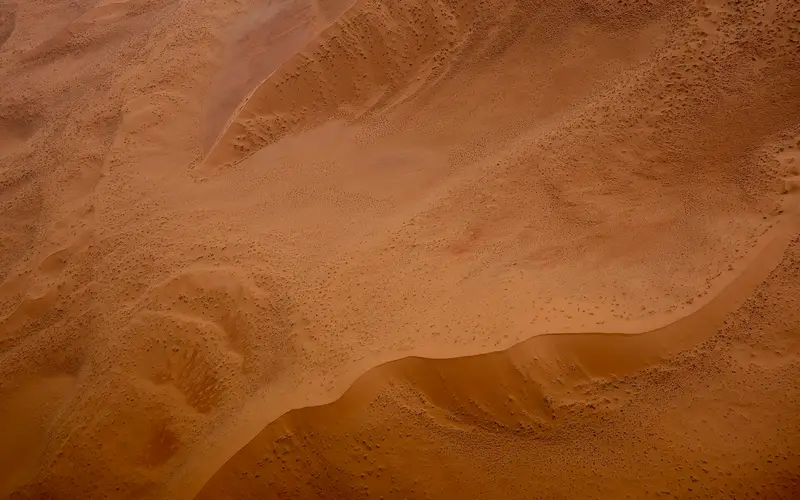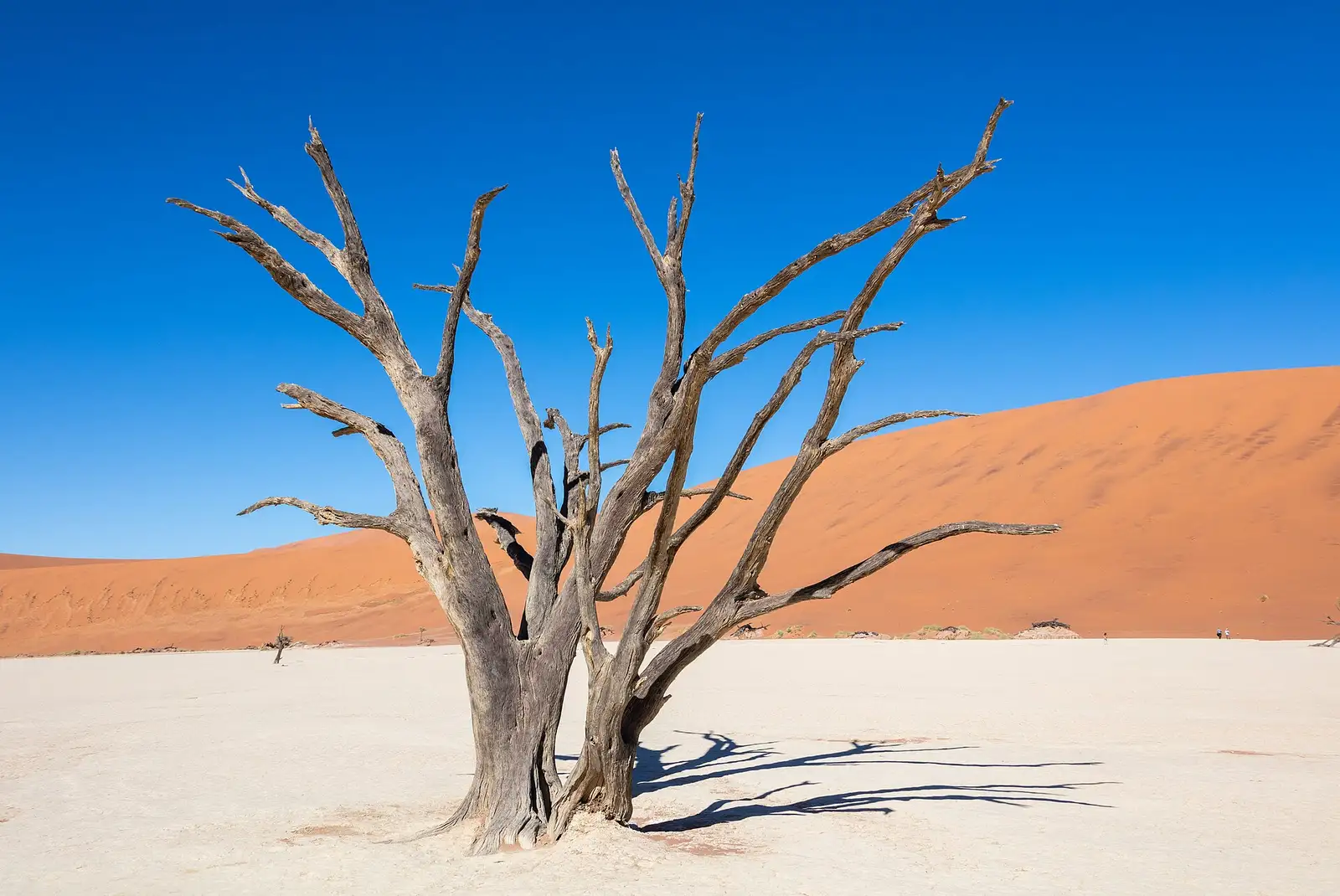
The standard route from Swakopmund to Sossusvlei is the C14: 35 km of tar to Walvis Bay, then about 285 km of gravel through the Namib-Naukluft, via the Kuiseb and Gaub canyons, to Solitaire. From there, the C19 runs south to Sesriem. Expect around 345–360 km and 5–6 hours of driving, or 7–8 hours with stops. Sossusvlei isn’t a day trip, so plan to sleep near Sesriem, ideally inside the park gate if you want to catch sunrise at Deadvlei. One big change for 2026: private cars can no longer drive the last sandy kilometres to the pans, so plan on using the official shuttle. For the wider desert, from the dune sea to the gravel plains, see our Namib Desert guide.
Distances
How far is it from Swakopmund?
Road distances and realistic driving times from the town centre. Gravel roads are slower than they look on a map.
| Destination | Distance | Drive time | Road |
|---|---|---|---|
| Mondesa township | 4 km | 10 min | tar |
| Dune belt (sandboarding & quads) | 6 km | 10 min | tar |
| Walvis Bay Waterfront | 35 km | 30 min | tar |
| Moon Landscape | 35 km | 40 min (gravel) | gravel |
| Dune 7 | 38 km | 35 min | tar |
| Walvis Bay Lagoon (flamingos) | 38 km | 35 min | tar |
| Goanikontes Oasis | 40 km | 50 min (gravel) | gravel |
| Zeila shipwreck | 60 km | 45 min | tar |
| Pelican Point | 65 km | 1 h 30 (4x4 only, or by boat) | 4x4 |
| Welwitschia Plains | 65 km | 1 h 15 (gravel) | gravel |
| Henties Bay | 75 km | 50 min | tar |
| Sandwich Harbour | 80 km | 2 h (4x4 only, tide-dependent) | 4x4 |
| Cape Cross Seal Reserve | 125 km | 1 h 30 | gravel |
| Spitzkoppe | 150 km | 2 h | gravel |
| Brandberg | 220 km | 3 h | gravel |
| Windhoek | 360 km | 4 h | tar |
| Sossusvlei | 400 km | 6 h (mostly gravel) | gravel |
Route options at a glance#
| Route | Distance | Road | Best for |
|---|---|---|---|
| C14 via Walvis Bay, Kuiseb & Solitaire | approx. 345–360 km | Mostly gravel | Almost everyone; the shortest and most scenic route |
| Via Windhoek on tar (B2/B1), then south on C24/C19 or C26 | approx. 650–700 km | Tar to Windhoek, then gravel | Combining with Windhoek, or visiting Windhoek in between |
| Guided tour from Swakopmund | n/a | Operator drives | Solo travellers, backpackers without a car |
| Scenic or charter flight | approx. 2 hours | Air | Short on time, bigger budgets |
Unless you specifically need to go via Windhoek, take the C14. The Windhoek route roughly doubles the distance, and you still end up on gravel for the last few hours.
The C14 route step by step#
Swakopmund → Walvis Bay (approx. 35 km, tar, 30 minutes)#
Head south on the B2 coastal road past Long Beach to Walvis Bay. This is your last chance for full-size supermarkets, ATMs and the cheapest fuel, so fill the tank, buy water (at least 5 litres per person), snacks and a picnic lunch. The C14 leaves Walvis Bay to the east, passing Dune 7 and the airport. If you’d rather break the journey on the coast, our Walvis Bay travel guide covers where to stay and eat.
Walvis Bay → Kuiseb Canyon (approx. 130 km, gravel)#
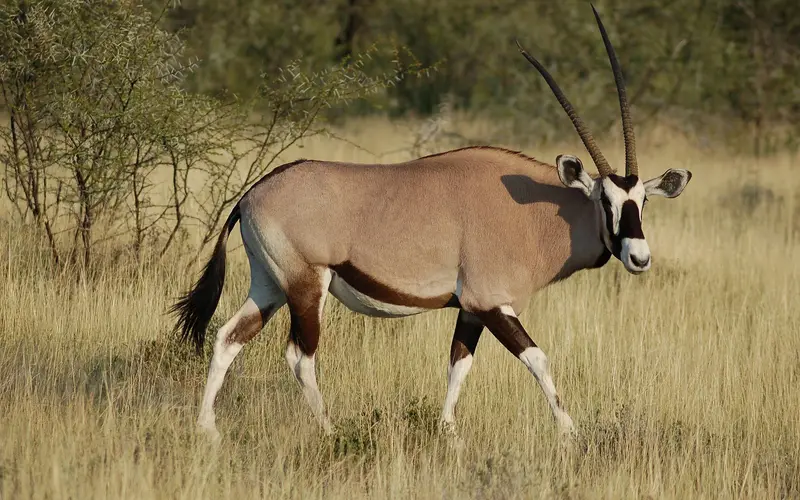
The tar ends shortly after Walvis Bay, and the C14 crosses wide, flat gravel plains inside the Namib-Naukluft Park. Look for springbok, oryx and ostriches, and for small mirages shimmering on the horizon. You don’t need a permit to drive the C14 itself, but you do need one for detours onto marked side roads in the park, such as Vogelfederberg or Blutkuppe. NWR’s office in Swakopmund issues these.
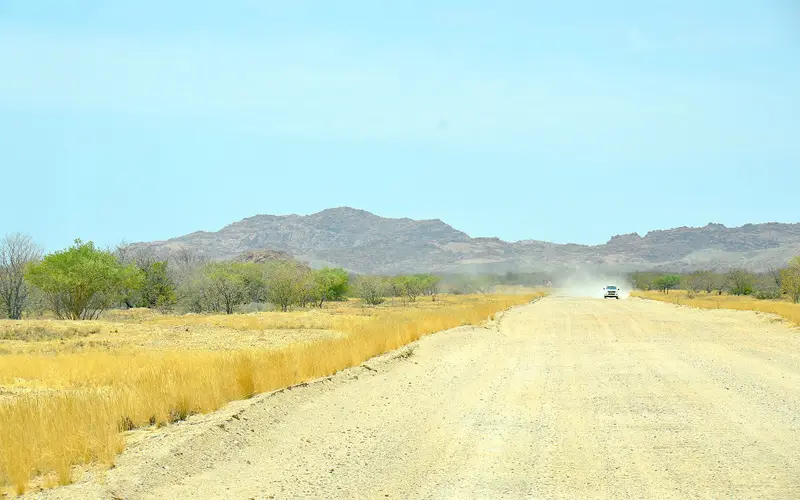
Road quality on this stretch changes from month to month. Recently graded sections are fast, but corrugations and loose gravel are common, especially as you approach the Kuiseb.
After about 90 km of plains, the road drops into the Kuiseb Canyon via the Kuiseb Pass, with sharp bends, steep sections and blind corners. Slow down and stay on your side of the road. Near the pass is the viewpoint for the area where two German geologists, Henno Martin and Hermann Korn, hid for more than two years during the Second World War to avoid internment, a story told in Martin’s book The Sheltering Desert.
Kuiseb → Gaub Pass → Solitaire (approx. 100 km, gravel)#
Shortly after the Kuiseb comes the Gaub Pass, another twisting descent and climb through a dry riverbed. Then the landscape opens into golden grasslands framed by mountains. Somewhere along here you’ll pass the Tropic of Capricorn sign, a mandatory photo stop.
Solitaire is a tiny settlement of a fuel station, general store, lodge and a famous bakery, surrounded by rusting vintage car wrecks half-buried in sand. Its apple crumble has become legendary among overlanders. This is the natural lunch stop and your second fuel stop, about 230 km from Swakopmund.
Solitaire → Sesriem (approx. 80 km, gravel)#
From Solitaire, the C19 runs south for around 70 km before you turn west onto the short road to Sesriem and the park gate. The red dunes start appearing on the horizon, and the road can be sandy and corrugated in places. Sesriem has a fuel station and shop at the gate (Sossus Oasis), the NWR Sesriem campsite, and a cluster of lodges and campsites spread along the C19 and C27 nearby.
Road conditions and driving tips#
The C14 is one of Namibia’s busiest gravel roads, used by tour trucks, rental 4x4s and freight, and its condition varies a lot. Some stretches are smooth after grading; others are corrugated, stony or sandy.
- Speed: Plan on an average of about 80 km/h on gravel, slower on passes and corrugations. Many rental agreements cap speed on gravel, and most serious accidents in Namibia are rollovers on gravel caused by speed or overcorrecting.
- Tyre pressure: Follow your rental company’s advice. Many recommend slightly lower pressure for long gravel stretches; reinflate before tar.
- Dust: Turn on your headlights so oncoming drivers can see you through dust clouds. When overtaking or being overtaken, slow down and wait until you can see.
- Wildlife: Springbok, oryx and ostriches cross without warning, especially at dawn and dusk.
- Night driving: Don’t. Many rental contracts forbid it, and animals, unlit vehicles and potholes make it genuinely dangerous.
- Punctures: Carry a working spare (two is better), know how to change a tyre, and check pressures at every fuel stop.
- Flash floods and rainy-season closures: After heavy rains inland (usually January–April), the Kuiseb and Gaub riverbeds can flood. In the exceptionally wet 2025/26 season, the route between Walvis Bay and Sesriem was cut at times and the tracks around Sossusvlei turned to mud. Between November and April, ask your rental company or lodge about road conditions the day before, keep a buffer day, and never drive into flowing water.
Read our car rental guide for choosing between a 2WD and 4x4, gravel-road insurance cover and what to check at pick-up.
Fuel and supplies#
| Stop | Approx. km from Swakopmund | Fuel | Food & supplies |
|---|---|---|---|
| Walvis Bay | 35 | Yes, several stations | Supermarkets, ATMs, pharmacies |
| Solitaire | 230 | Yes | Bakery, small shop, lodge restaurant |
| Sesriem | 345–360 | Yes, at the gate | Small shop, campsite bar and lodge restaurants |
Fuel prices are set monthly at Walvis Bay: in October 2026, petrol was N$26.58 and diesel N$27.86 per litre there, and remote stations charge a little more. Card machines can fail at Solitaire and Sesriem, and small stations occasionally run out (diesel more often than petrol), so carry enough cash for at least one full tank and never pass Walvis Bay with less than a full one. Attendants fill up for you; tip N$5–N$10.
Timing your arrival for Deadvlei and Dune 45#
Most people want to be at Deadvlei or Dune 45 when the first light hits the dunes. The key fact: the outer Sesriem gate opens at sunrise, but the inner gate opens about an hour earlier for guests staying inside the park. That hour makes all the difference.
- Inside the gate: NWR’s Sesriem campsite and Sossus Dune Lodge, plus a few other properties inside the park boundary, let you leave before sunrise. This is the only way to reach Dune 45 (45 km from Sesriem) or Deadvlei (about 65 km) for actual sunrise. Book months ahead for peak season.
- Outside the gate: You enter at sunrise and will reach Dune 45 within roughly 45 minutes and Deadvlei within roughly 75–90 minutes, including the shuttle transfer. The light is still beautiful, and you’ll avoid the midday heat if you start walking by 08:00–08:30.
Gate times move in steps through the year, from around 06:00 in summer to around 06:45–07:00 in midwinter at the outer gate. Ask at your campsite or lodge the evening before.
Suggested timing from Swakopmund#
- Day 1: Leave Swakopmund by 08:00. Fuel in Walvis Bay, stop at the Kuiseb Canyon, the Tropic of Capricorn and Solitaire for lunch, and reach Sesriem by 15:00–16:00. Visit Sesriem Canyon or watch the sunset from Elim Dune, both close to the gate.
- Day 2: Enter the park at opening time. Climb Dune 45 or go straight to Deadvlei, explore until about 10:30 before the heat builds, then visit Sossusvlei itself. Rest at your camp in the afternoon.
- Day 3: Optional second dawn, or continue to your next stop.
The final stretch: Sesriem to Deadvlei#
From the gate, a 60 km tarred road runs to the 2x4 car park. After that, the last 5–6 km to Sossusvlei and the Deadvlei car park is deep sand.
The 2026 rules: after two earlier attempts were postponed following industry protests, the Ministry of Environment, Forestry and Tourism announced in April 2026 that from 1 May 2026 self-drive vehicles may no longer go beyond the 2x4 car park, whatever they are. Visitors park there and continue on the official concession shuttle, which was reported at approx. N$260 return per adult, with children at half price. Apart from the shuttle, only NTB-registered guides employed by lodges in and around the park may drive the stretch, and only with their own guests, so many tour groups from Swakopmund also switch to the shuttle here.
What this means in practice:
- Your 4x4 brings no advantage for the final stretch; a 2WD car is just as good for reaching the 2x4 car park.
- Allow extra time at the car park, especially in the first hour after the gate opens when everyone arrives at once, and carry cash in case card payment fails.
- The decision has been criticised by the tourism industry for creating a single-operator monopoly, so the arrangements could change again. Check the current rules and fare with your accommodation before you go.
From the Deadvlei car park, it is about 1.1 km of walking across soft sand to the pan. Allow 20–30 minutes each way and carry plenty of water. Big Daddy, at roughly 325 m one of the tallest dunes in the area, rises beside Deadvlei; the climb takes 1.5–2 hours and is hard work in soft sand.
Park fees#
Sossusvlei is in the Namib-Naukluft Park, which is in the premium fee category. From 1 April 2026, foreign adults pay approx. N$280 per person per day, SADC nationals approx. N$180 and Namibians approx. N$60, plus a vehicle fee. Pay at the Sesriem visitor centre. Your permit is valid per day, so keep the receipt.
Self-drive vs tours from Swakopmund#
Self-drive#
Pros: total flexibility, your own timing for sunrise, cheaper for groups of three or four, and you can combine Sossusvlei with the rest of a Namibia loop. Cons: around 700 km of gravel driving for a return trip, rental costs and insurance, and the responsibility for punctures and fuel planning.
Guided tours#
Several Swakopmund operators run 2- and 3-day Sossusvlei tours, usually camping-based, with transport, park fees, meals and a guide included. Expect approximately N$6,000–N$12,000 per person in 2026 depending on group size, camping vs lodge accommodation and how many nights you stay. Some tours drop you in Windhoek at the end, which saves you backtracking.
Pros: no gravel driving, a guide who knows the dunes, and often good value for solo travellers. Cons: fixed schedules, some tours stay outside the gate (so you’ll miss true sunrise), and the shuttle fare for the last stretch may not be included, so ask.
Scenic flights#
Swakopmund-based scenic-flight operators fly over Sossusvlei, the Namib Sand Sea and the coast in about 2–2.5 hours. Prices depend heavily on how many seats are filled, and it is a sightseeing flight, not a transfer. Some lodge packages include one-way light-aircraft transfers between Sossusvlei and Swakopmund instead.
Compare all your options in our Swakopmund tours and packages guide. If Sossusvlei is one stop on a longer trip, our Namibia road trip itinerary shows how to fit it in with Swakopmund, Damaraland and Etosha.
What to pack for the drive#
- At least 5 litres of water per person, plus extra in the car
- Snacks and a packed lunch (Solitaire can be crowded)
- Cash for fuel, park fees and small purchases
- A headlamp for pre-dawn starts
- Warm layers: desert mornings can be cold, even in summer
- Sunscreen, hat and sunglasses
- Good shoes for the sandy walk to Deadvlei
- Offline maps (mobile coverage is patchy between Walvis Bay and Solitaire)
See our Swakopmund packing list for the full checklist.
Common mistakes#
- Trying to do Sossusvlei as a day trip from Swakopmund. You’ll spend 11+ hours in the car and see the dunes in the harshest light.
- Not booking inside the gate and then expecting to be at Deadvlei for sunrise.
- Skipping fuel in Walvis Bay because “there’s fuel at Solitaire”. There usually is, but don’t rely on a single remote pump.
- Driving too fast on good-looking gravel. Smooth sections can turn corrugated or sandy without warning.
- Arriving at Deadvlei at noon with half a litre of water. Temperatures in the pans can be brutal by late morning.
- Assuming you can drive your own 4x4 to Deadvlei. Since May 2026 you can’t; budget time and money for the shuttle, and check whether the rules have changed again.
- Planning a tight schedule in the rainy season. In a wet year, an inland storm can close the C14 or C19 for a day or more. See our best time to visit Namibia guide.
Going the other way: Sossusvlei to Swakopmund#
The route works just as well in reverse, and many travellers drive Sossusvlei first and then rest in Swakopmund. Leave Sesriem after breakfast, lunch in Solitaire, and you’ll be at the coast by late afternoon. The temperature drop as you approach Walvis Bay is dramatic, often 15°C or more, so keep a jacket handy. Once you arrive, our Swakopmund travel guide and best day trips from Swakopmund will help you plan your next few days, and our how to get to Swakopmund guide covers other routes in and out of town.
Photo gallery
Frequently asked questions
How long does it take to drive from Swakopmund to Sossusvlei?
The drive to Sesriem, the gateway to Sossusvlei, takes about 5–6 hours of actual driving for roughly 350 km, most of it on gravel. With stops at Kuiseb Canyon, the Tropic of Capricorn and Solitaire, most people take 7–8 hours.
Can I drive from Swakopmund to Sossusvlei in a normal car?
Yes, in dry conditions. The C14 and C19 are gravel roads that a 2WD car can manage at sensible speeds, although high clearance helps. Since 1 May 2026 no self-drive vehicle, 4x4 or not, may continue beyond the 2x4 car park; the final sandy stretch to Sossusvlei and Deadvlei is covered by the official shuttle.
Can I do Sossusvlei as a day trip from Swakopmund?
Not realistically. The return drive alone is 10–12 hours on gravel, you would miss the early morning light, and night driving is dangerous. Stay at least one night near Sesriem, ideally two.
What time does the Sesriem gate open for sunrise?
The main gate opens around sunrise, and the time shifts through the year. Guests staying inside the park gate can leave about an hour earlier, which is the only way to reach Deadvlei or Dune 45 for sunrise itself.
Is there fuel between Walvis Bay and Sossusvlei?
Yes, at Solitaire, about 230 km from Swakopmund, and at Sesriem near the park gate. Fill up in Walvis Bay first and carry cash, as card machines at remote fuel stations aren't always reliable.
Is it better to take a tour from Swakopmund to Sossusvlei?
If you don't have a car or are travelling solo, a 2–3 day guided camping or lodge tour is usually easier and often cheaper than renting a car alone. Groups of three or four usually save money by self-driving.