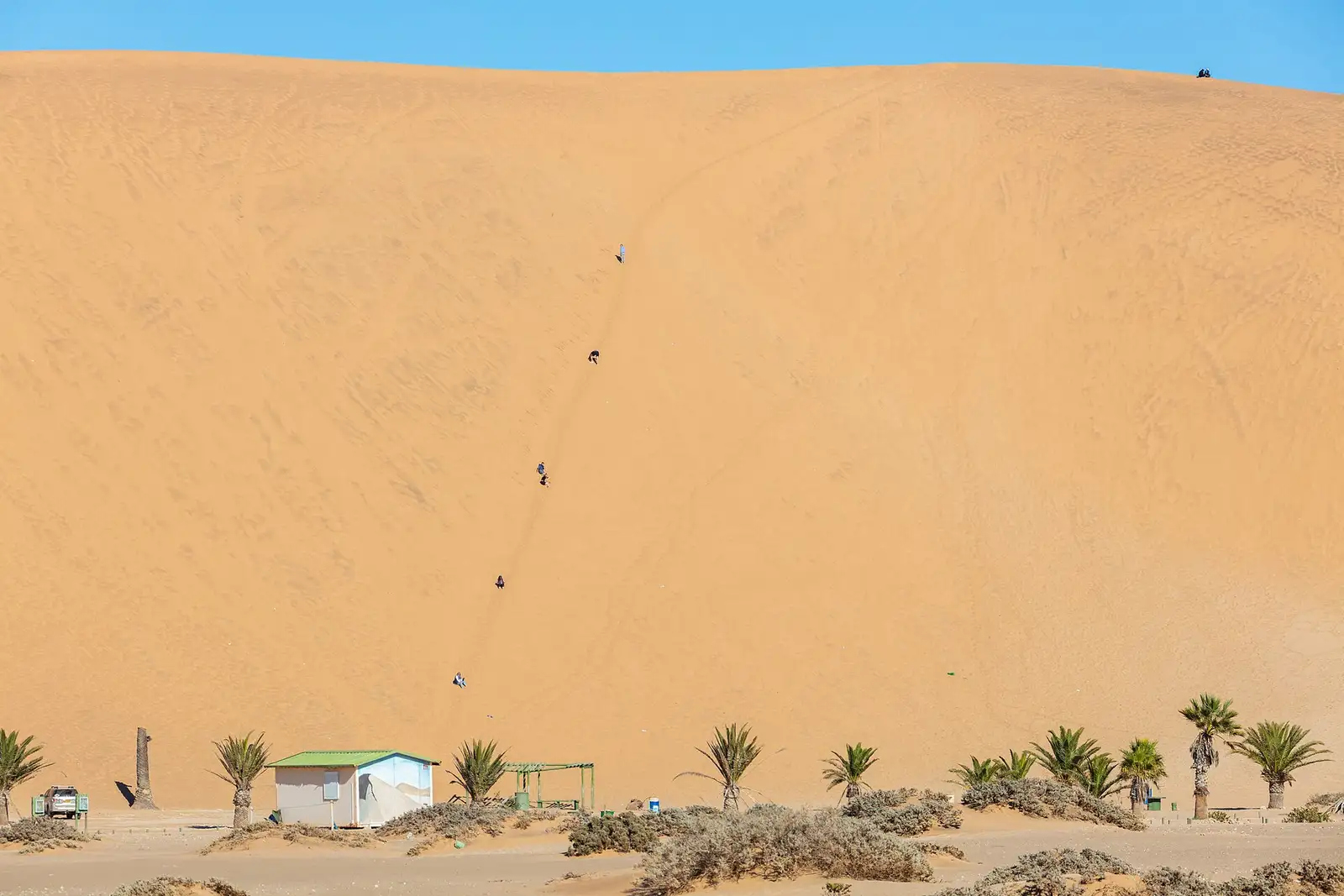
Dune 7 is the big dune on the eastern edge of Walvis Bay, just off the C14 road to the airport and about 40 km (35–40 minutes) from Swakopmund. Its height is commonly quoted as around 380 m, making it one of the tallest dunes on the Namibian coast. You can climb it in 30–60 minutes, run down the steep face in a few, and picnic under the palm trees at its base. An MEFT entry fee has been charged since December 2022, and it is best climbed early in the morning.
What is Dune 7?#
Dune 7 is part of the coastal dune belt that runs from Walvis Bay to Swakopmund. It lies inside Dorob National Park, and for decades it was a free local landmark for picnics, fitness climbs and sunsets.
The name is usually explained in one of two ways: either it was the seventh dune counted or crossed by early surveyors, or it is named after its distance from town. Nobody seems quite sure, so do not be surprised if your guide tells a different story.
How high is it? Figures of about 383 m (1,256 ft) are widely published, including by Namibian media, and they put Dune 7 among the tallest dunes in Namibia. However, published heights for Namibian dunes are often muddled between height above sea level and height from base to crest. Whatever the exact number, it is a long, steep climb with soft sand all the way.
Entry fee and opening#
The Ministry of Environment, Forestry and Tourism (MEFT) introduced an entry fee on 1 December 2022, along with a fence, gate and reception area. The published rates at the time were:
| Visitor | Fee (from December 2022) |
|---|---|
| International adult | N$150 |
| International child (8–16) | N$100 |
| SADC adult | N$100 |
| SADC child (8–16) | N$50 |
| Namibian adult | N$50 |
| Namibian child under 16 | Free |
| Vehicle | Additional vehicle fee |
Has it gone up? Namibia increased national park fees on 1 April 2026, which roughly doubled entry to premium parks for foreign visitors. We could not confirm the new Dune 7 rate at the time of writing, so expect it to be higher than the table above and check at the gate or with MEFT. Bring cash in Namibian dollars or rand in case card machines are down.
Management: in June 2023, MEFT awarded the management and development of the site to a private concessionaire, Sandwich Dune Tours and Safari. Plans announced at the time included a restaurant with a pool and bar, chalets, paragliding, stargazing and dune climbing activities. Some of these may not be operating yet, so check what is open before you plan a meal or overnight stay around them.
Opening hours: daylight hours. We could not confirm exact gate times for 2026, so aim to arrive after about 08:00 and leave well before dark.
Getting to Dune 7#
| From | Distance | Time | Road |
|---|---|---|---|
| Walvis Bay centre | approx. 8–10 km | 10 minutes | Tar (C14) |
| Walvis Bay airport | approx. 5–10 km | 10 minutes | Tar (C14) |
| Swakopmund | approx. 40 km | 35–40 minutes | Tar (B2, then C14) |
Follow the C14 east from Walvis Bay towards the airport and look for the signposted turn-off to the dune. The access road to the picnic area is sandy in places but normally fine for an ordinary car. Park in the main area rather than driving onto soft sand.
Without a car: take a taxi from Walvis Bay and agree a pick-up time, or join a Walvis Bay day tour that includes a stop. See our Walvis Bay day trip guide for combinations.
Climbing Dune 7#
There is no marked path. Most people walk up the ridge (crest line), which is firmer and less steep than the open face.
- Start at the picnic area and head for the obvious ridge to the left or right of the main face.
- Walk in the footprints of people ahead of you. Compacted sand is much easier.
- Use the “two steps up, one slide back” rhythm. Short steps and regular pauses are faster than charging.
- Stop at the first high point if you are tired. The view is already good there.
- Come down the steep face. Running or sliding down the slip face is the best part and takes only minutes.
| Fitness level | Time to a good viewpoint | Time to the top |
|---|---|---|
| Very fit | 20–30 minutes | 40 minutes |
| Average | 30–45 minutes | about 1 hour |
| Taking it easy | 45+ minutes | Optional |
The view: on clear days you see the dune sea rolling east, Walvis Bay, the lagoon and the Atlantic. On hazy or foggy days the view can disappear completely, which is common on summer mornings. Check the sky before you start: if the fog is thick in town, it may lift in an hour or two.
Sandboarding and other activities#
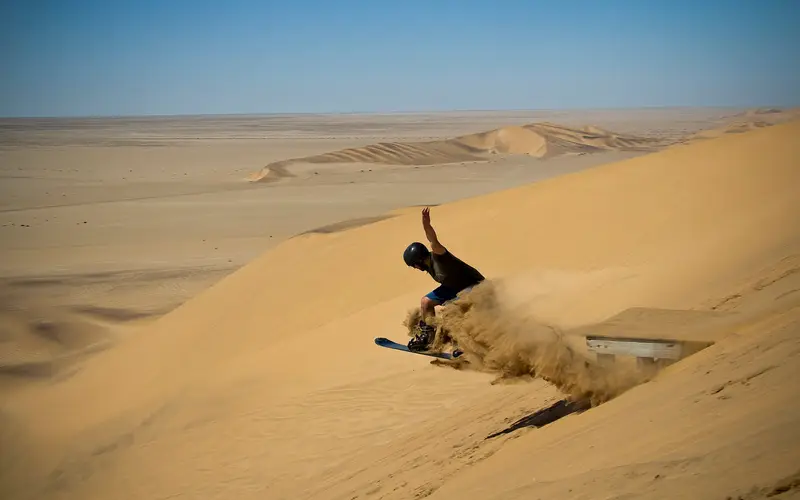
Dune 7 is steep enough for sandboarding, and you will sometimes see locals sliding down on boards or sheets of hardboard. However, there is no regular sandboarding operator with board hire based at the dune, and you would have to carry your board up a very long climb.
For a proper session, book a guided trip. Operators work in the dune belt between Swakopmund and Long Beach, with transport, boards, a safety briefing and repeated runs on well-chosen faces. Our sandboarding in Swakopmund guide compares operators and prices, and quad biking can be combined on the same morning.
The picnic area#
At the foot of the dune, a grove of palm trees shades concrete tables and braai (barbecue) spots. MEFT renovated the area and built new toilets when the fee was introduced, after years of complaints about vandalism and litter.
- Bring your own food, water and firewood or charcoal if you want to braai.
- Take all your rubbish home. Litter was one of the reasons the site was fenced.
- Weekends and public holidays are busy with local families, especially in December and January. Weekday mornings are quiet.
Best time to climb Dune 7#
- Time of day: early morning is best. The sand is cool, the air is still, and you beat the crowds. Late afternoon can also work on calm days, but the wind usually picks up from late morning and blasts sand along the ridge.
- Season: any time. Summer (December–February) is warmer and busier. Winter is cooler, but east-wind days (mostly from about April to July) bring hot air, haze and blowing sand. Skip the climb on those days.
- Sunset: pretty, but leave enough time to get down before dark and before the gate closes.
For month-by-month weather, see our Swakopmund weather guide. Walvis Bay’s climate is almost identical.
What to bring#
- Water. At least 1 litre per person. There is no shade on the dune.
- A hat, sunglasses and sunscreen. Fog does not stop sunburn.
- A windproof layer and a buff or scarf for blowing sand.
- Shoes you can empty, or carry your shoes and go barefoot.
- A phone in a zip-lock bag. Fine sand gets into everything.
- Cash for the entry fee.
Our packing list has more.
Combining Dune 7 with other sights#
Dune 7 is an easy add-on to a day in Walvis Bay:
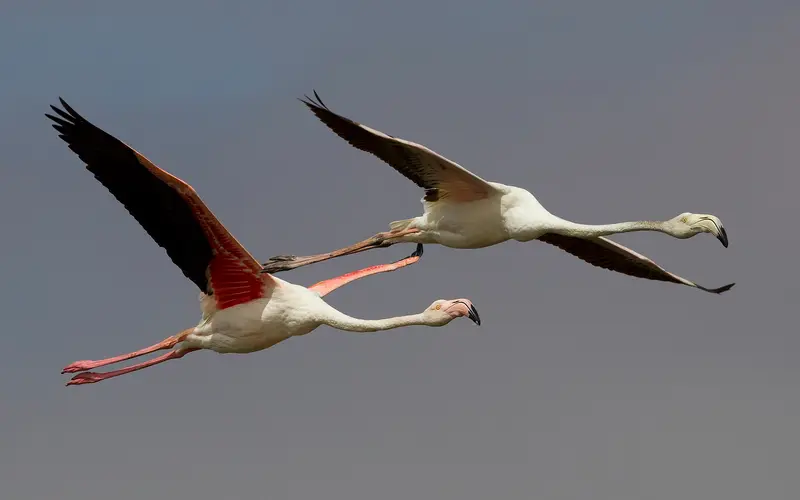
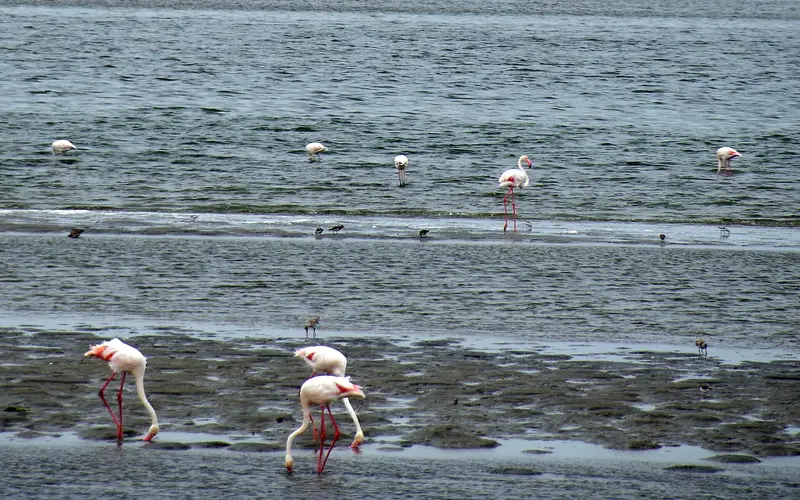
- Morning: climb Dune 7 at about 08:00, then see the flamingos on the lagoon.
- Midday: a seafood lunch at the Waterfront.
- Afternoon: a Sandwich Harbour tour or a drive to the salt works.
If you are combining it with Pelican Point or Sandwich Harbour, where the tide decides the timing, check our tide times guide first and fit Dune 7 around the tide-dependent trip. It is also a convenient stop on your way to or from Walvis Bay airport if you have a few hours to spare. For everything else in town, see our Walvis Bay travel guide.
Common mistakes#
- Starting at midday. Hot sand and strong wind make it miserable.
- Taking no water. It is a bigger climb than it looks from the car park.
- Wearing trainers with mesh. They fill with sand. Go barefoot or wear sandals.
- Bringing an expensive camera without protection. Wind-blown sand scratches lenses.
- Budgeting with old fees. Prices quoted in older guides are likely out of date after the April 2026 increase.
Dune 7 vs other dunes in Namibia#
- Dune 7: tall, quick to reach from town and cheap, but the colour is pale and the view is often hazy.
- The dunes near Swakopmund: free to explore south of the Swakop River and where most sandboarding and quad biking happens.
- Sossusvlei (Dune 45, Big Daddy): red, iconic and photogenic, but about 5 hours’ drive away. Read our Namib Desert guide for the full picture.
Photo gallery
Frequently asked questions
How high is Dune 7?
It is usually quoted as about 383 m (1,256 ft), which would make it one of the tallest dunes in Namibia. Published figures vary and some appear to measure elevation rather than base-to-crest height, but either way the climb is long and steep.
How much does it cost to enter Dune 7?
An MEFT entry fee has been charged since 1 December 2022. It was then N$150 for international adults, N$100 for SADC adults and N$50 for Namibian adults, plus a vehicle fee. Namibia raised park fees in April 2026, so confirm the current rate at the gate.
How long does it take to climb Dune 7?
Most fit people reach a good viewpoint in 30–45 minutes, and the highest crest in about an hour. Coming down the steep slip face takes only a few minutes.
Can you sandboard on Dune 7?
People do slide down the steep face on boards, but there is no regular sandboarding operation with equipment hire on the dune. For lessons, gear and guides, book a sandboarding trip in the dune belt between Swakopmund and Walvis Bay.
Can I visit Dune 7 without a car?
Yes. Take a taxi from Walvis Bay, which is about 10 minutes away, and arrange the return trip in advance. Some Walvis Bay and Swakopmund tours also stop there. There is no public transport to the gate.
Is Dune 7 worth it?
Yes, if you enjoy a physical challenge and are in the area anyway. The climb is tough, and the view over the dune sea and Walvis Bay is good on clear days. If you are heading to Sossusvlei, its red dunes are more photogenic, so treat Dune 7 as a workout with a view.