The Namib is a coastal desert running along Namibia’s Atlantic shore, and it may be the oldest desert on Earth, arid for somewhere between 55 and 80 million years. It is a place of extremes: pale coastal dunes wrapped in Atlantic fog around Swakopmund, and some of the tallest red dunes in the world at Sossusvlei, 350 km to the south-east. You can experience it in a morning from Swakopmund, but to see the famous red dunes and Deadvlei you need at least two nights near Sesriem.
This guide explains how the Namib works (fog, sand and survival), what lives there, and the best ways to experience it from Swakopmund and Sossusvlei, with approximate 2026 costs. Prices and park fees change, so confirm before you go.
The Namib Desert in numbers#
| Fact | Detail |
|---|---|
| Location | Atlantic coast of Namibia, plus southern Angola and north-western South Africa |
| Length | approx. 1,600 km in its core (more than 2,000 km under the broadest definition) |
| Width | approx. 50–160 km, from the ocean to the Great Escarpment |
| Age | Arid or semi-arid for roughly 55–80 million years |
| Rainfall | approx. 5 mm a year in the west to around 85 mm in the east |
| Fog | More than 180 foggy days a year in some coastal areas |
| Highest dunes | Several around Sossusvlei exceed 300 m |
| Protected areas | Namib-Naukluft National Park (approx. 50,000 km², one of Africa’s largest), Dorob National Park, Skeleton Coast National Park |
| World Heritage | Namib Sand Sea, inscribed by UNESCO in 2013 (core area approx. 30,800 km²) |
The name comes from the Nama language and is usually translated as “vast place” or “an area where there is nothing”, which is not quite true, as you will see.
How the Namib works#
Why it is a desert#
The Namib owes its existence to the cold Benguela Current, which flows north along the coast from Antarctic waters. Cold water cools the air above it, so the air is too stable to rise and form rain clouds. Add the dry, sinking air that dominates this latitude, and you get one of the driest places on the planet. Swakopmund averages only around 15–20 mm of rain a year.
Fog: the desert’s water supply#
The same cold current creates the Namib’s lifeline: fog. When moist air from the ocean passes over the cold water, it condenses into fog banks, which the sea breeze pushes inland, often 20–50 km and sometimes further. On the coast, fog can occur on more than 180 days a year. Lichens, plants, beetles, lizards and even some mammals depend on it for moisture. It is also why Swakopmund mornings are so often grey; see our Swakopmund weather guide.
Where the sand comes from#
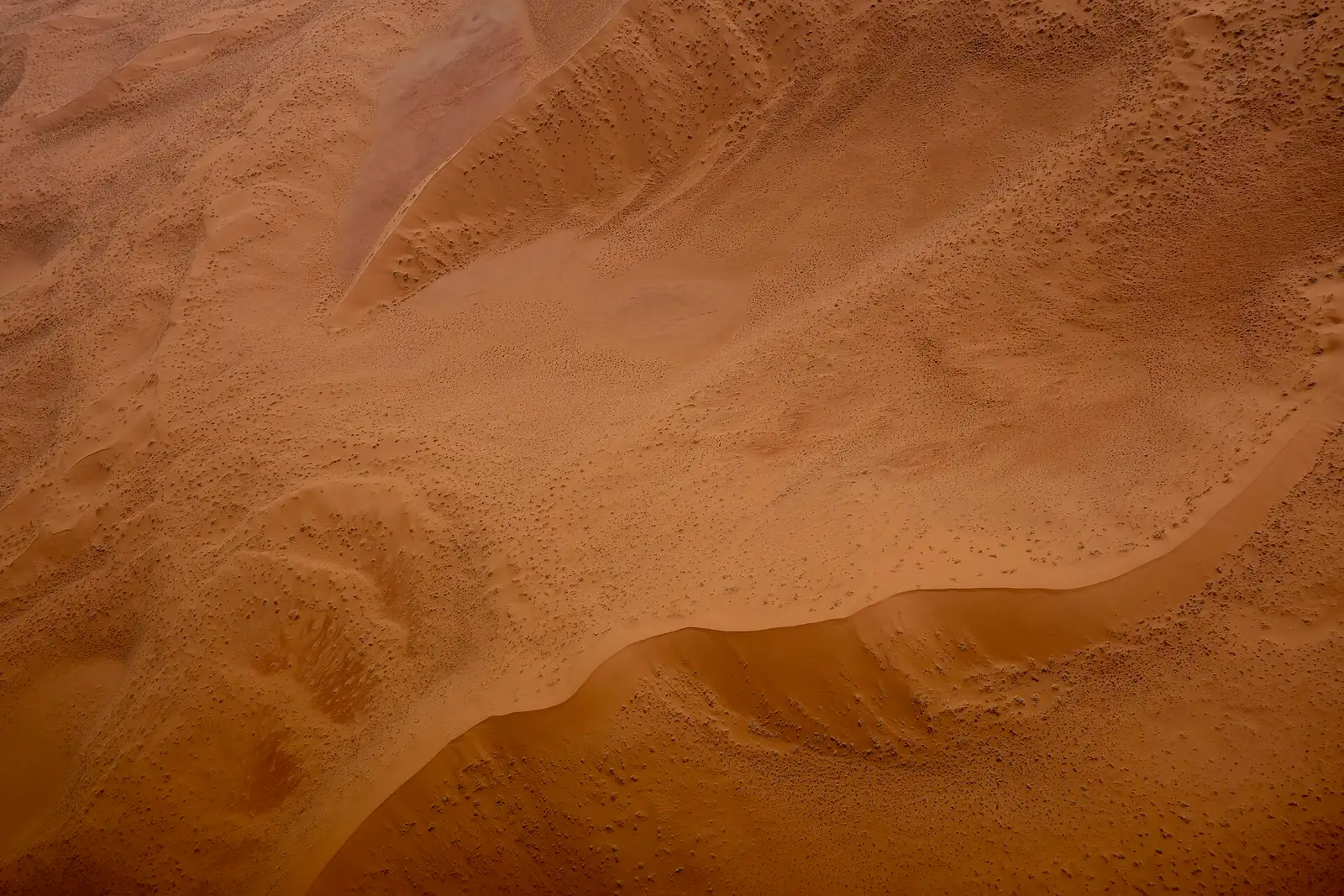
Most of the Namib’s sand was carried to the sea by the Orange River on the South African border, then swept north by ocean currents and blown inland by the strong south-westerly winds. Scientists describe the sand sea as a wind-displaced delta of the Orange River. Over millions of years, iron oxide coating on the grains has turned the older inland dunes deep orange and red, while the younger coastal dunes near Swakopmund and Walvis Bay are paler.
Types of dunes#
- Linear dunes: long parallel ridges, some stretching for tens of kilometres, best seen from the air.
- Star dunes: tall dunes with several arms, formed where winds blow from different directions. The giants around Sossusvlei are mostly star dunes.
- Crescent (barchan) dunes: smaller, mobile dunes on the coastal plains.
- Coastal dune belt: the band of dunes between Swakopmund and Walvis Bay, where sandboarding and quad biking take place.
Life in the Namib#
Plants#
- Welwitschia mirabilis: found only in the Namib. It grows just two leaves, which split and fray over centuries, and absorbs fog moisture. The biggest plants are many centuries old; the giant welwitschia on the Welwitschia Drive near Swakopmund is commonly estimated at more than 1,500 years old.
- Lichen fields: the gravel plains inland from the coast are covered in slow-growing lichens that “wake up” in fog. Tyre tracks across them last for decades, which is why off-road driving is banned.
- !Nara melon: a spiny, leafless plant on the dunes whose fruit has been eaten by the Topnaar people for centuries.
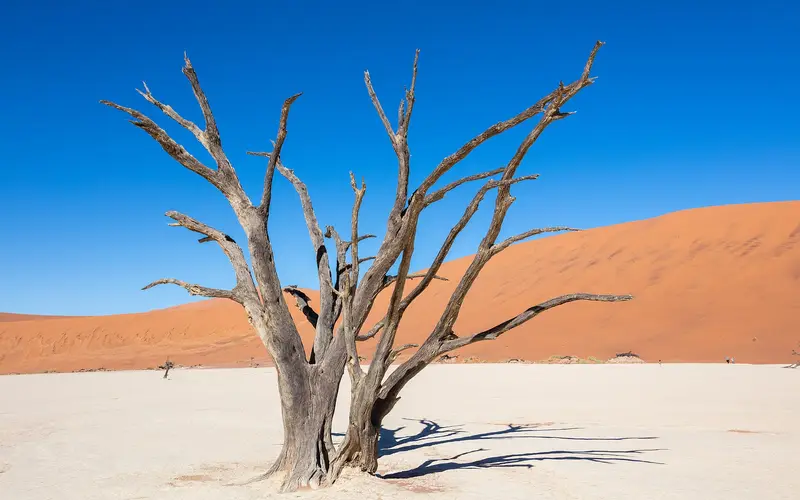
- Camel thorn trees: the dead trees of Deadvlei are camel thorns that died several centuries ago when the river stopped reaching the pan; the dry air has kept them from decaying.
Animals#
The Namib may have more endemic species than any other desert, most of them small.
- Fog-basking beetles (tok-tokkies such as Onymacris unguicularis) climb dune crests at dawn, tilt their bodies into the fog and drink the droplets that run down their backs.
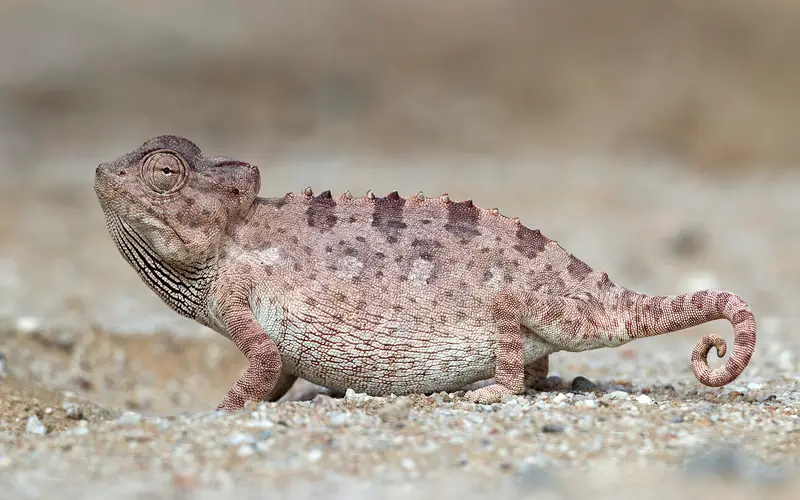
- The “Little Five”: the Namib web-footed gecko, Peringuey’s adder (sidewinder), Namaqua chameleon, shovel-snouted lizard and the dancing white lady spider. A Living Desert tour from Swakopmund is the best way to find them.
- Oryx (gemsbok): the symbol of the desert. They can let their body temperature rise to around 40°C to save water.
- Springbok, ostrich, jackal and brown hyena live on the gravel plains, and brown hyenas patrol the coast near seal colonies.
- Desert-adapted elephants, lions and rhinos live in the far north-west, in the dry riverbeds of Kunene, far from Swakopmund.
- Birds: the dune lark is Namibia’s only true endemic bird, and the coastal lagoons near Walvis Bay hold tens of thousands of flamingos.
Where to experience the Namib#
From Swakopmund: the coastal Namib#
Swakopmund sits right on the edge of the desert, and the dunes begin just south of town. You can do all of these as half-day or day trips with pickup from your accommodation:
| Experience | Time from Swakopmund | Approx. price (2026) | What it shows you |
|---|---|---|---|
| Sandboarding | 10 min | approx. N$700–N$800 | The coastal dune belt, up close and fast |
| Quad biking | 10 min | approx. N$600–N$1,200 | Dune scenery and views to the ocean |
| Living Desert tour | 10 min | approx. N$1,000 per adult | The desert’s small creatures and how they survive |
| Moon Landscape & Welwitschia Drive | 35–65 km on gravel | permit approx. N$280 per foreign adult + car fee | Lichen fields, eroded badlands, ancient welwitschias |
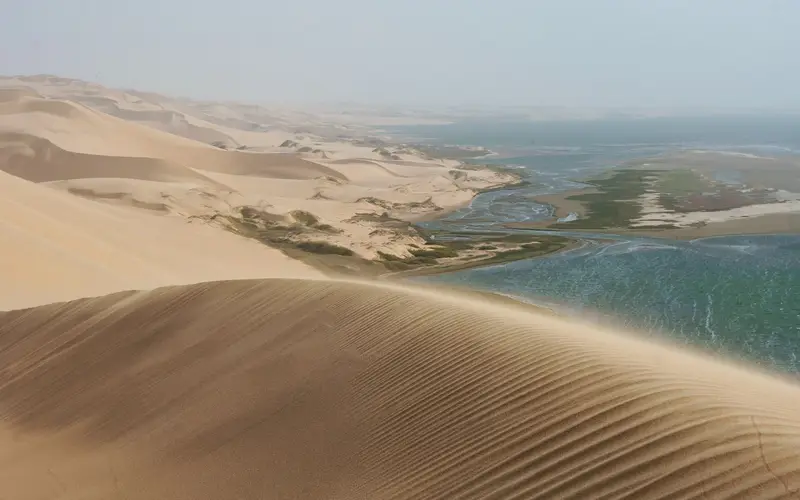
| Sandwich Harbour 4x4 tour | approx. 80 km, 4x4 only | approx. N$2,400–N$3,100 (half day) | Huge dunes plunging straight into the Atlantic |
| Skydiving or a scenic flight | Airfield on the edge of town | approx. N$4,700–N$5,000 for a tandem jump | The dune sea and coast from the air |
Swakopmund is also the base for the Skeleton Coast and Spitzkoppe, where the desert meets granite mountains. Compare all your options in our best day trips from Swakopmund guide.
Sossusvlei: the red heart of the Namib#
The image most people associate with the Namib, red dunes towering over white clay pans, comes from Sossusvlei in the Namib-Naukluft National Park, about 350 km from Swakopmund. Highlights include:
- Dune 45: a classic sunrise climb, 45 km from the Sesriem gate.
- Deadvlei: the white clay pan of dead camel thorn trees, about a 1.1 km walk across soft sand from the car park.
- Big Daddy: one of the tallest dunes in the area at roughly 325 m; allow 1.5–2 hours to climb.
- Sossusvlei itself: the pan where the Tsauchab River ends. After exceptional rain, as in early 2026, it can briefly hold water.
- Sesriem Canyon: a narrow gorge near the gate, best in the late afternoon.
Getting there: the drive from Swakopmund via Walvis Bay, the Kuiseb and Gaub passes and Solitaire takes 5–6 hours on mostly gravel roads. Our Swakopmund to Sossusvlei guide covers the route, fuel, gate times and the shuttle for the final sandy stretch.
Park fees: since 1 April 2026, foreign adults pay approx. N$280 per day for premium parks such as Namib-Naukluft (Sossusvlei), SADC nationals approx. N$180 and Namibians approx. N$60, plus approx. N$60 per day for a car with up to 10 seats. Fees are paid at the Sesriem gate.
Other ways to see the Namib#
- The Skeleton Coast north of Swakopmund, where the desert meets a wild, foggy coastline of shipwrecks and seal colonies, including Cape Cross.
- Scenic flights from Swakopmund over the Namib Sand Sea, Sossusvlei and the coast (about 2–2.5 hours).
- Hot-air balloon flights at sunrise near Sesriem (book well ahead; expensive).
- The NamibRand Nature Reserve south of Sesriem, a private reserve known for dark skies.
Tours vs self-drive#
Self-drive#
Pros: your own timing for sunrise, freedom to stop for oryx and photos, cheaper for groups of three or four. Cons: long gravel drives, punctures and fuel planning are your responsibility.
- A normal 2WD car is fine around Swakopmund (tar to the dune belt, gravel on the Welwitschia Drive). For Sossusvlei, a high-clearance vehicle is more comfortable; see our car rental guide.
- Never drive into the dunes yourself. Off-road driving is banned in the national parks and damages lichen fields for decades. Sandwich Harbour requires an experienced 4x4 guide because of tides and soft sand.
- Carry at least 5 litres of water per person and avoid driving after dark.
Guided tours#
Half-day and full-day desert tours from Swakopmund include pickup and usually snacks or lunch. For Sossusvlei, 2- and 3-day tours from Swakopmund, typically camping-based, cost approx. N$6,000–N$12,000 per person in 2026 depending on group size and accommodation. Ask whether you will sleep inside the park gate, which is the only way to reach the dunes for actual sunrise. See our tours and packages guide.
When to visit the Namib#
- Coastal Namib (Swakopmund): any time; mild, around 18–23°C, with morning fog.
- Inland Namib (Sossusvlei): April to September for comfortable days (nights can be cold in June–August). From October to March, temperatures often pass 35–40°C, so start at sunrise and finish dune walks by late morning.
- Photography: sunrise and late afternoon, when the low sun carves the dunes into light and shadow. Midday light is flat and harsh.
More detail is in our best time to visit Namibia guide.
What to bring#
- At least 2–3 litres of water per person for a half-day, more for Deadvlei and Big Daddy
- Sun hat, sunglasses and high-SPF sunscreen
- Closed shoes or socks for hot sand (it can burn bare feet by late morning)
- A warm layer for early mornings, even in summer
- A buff or scarf against wind-blown sand, and a bag to protect your camera
Respect the desert#
- Stay on marked roads and tracks. Lichen fields and gravel plains scar for decades.
- Don’t touch or pick welwitschias, and stay outside the fenced areas around old plants.
- Leave the wildlife be. Guides on Living Desert tours handle animals carefully; you shouldn’t.
- Take all rubbish with you, including cigarette butts and fruit peel.
- Don’t climb on the dead trees in Deadvlei.
Common mistakes#
- Treating Sossusvlei as a day trip from Swakopmund. It is 10–12 hours of round-trip driving; stay at least one night, ideally two.
- Climbing dunes at midday in summer with too little water.
- Judging the coastal dunes by the morning fog. The sun usually breaks through by late morning.
- Driving off-road or onto the beach in national parks.
- Skipping the small stuff. The Living Desert tour is often the highlight for people who expected “just sand”.
Photo gallery
Frequently asked questions
How old is the Namib Desert?
The Namib has been arid or semi-arid for roughly 55 to 80 million years, which is why it is often called the oldest desert in the world. The dune fields themselves are much younger and are constantly reshaped by the wind.
Where is the Namib Desert?
It runs along the Atlantic coast of south-western Africa, through Namibia and into southern Angola and north-western South Africa. In Namibia it stretches roughly 1,600 km from the Kunene region in the north to beyond Lüderitz in the south, and is 50–160 km wide.
Can you see the Namib Desert from Swakopmund?
Yes. Swakopmund sits on the edge of the Namib, and the coastal dune belt starts just south of town. Sandboarding, quad biking, the Living Desert tour, the Moon Landscape and Sandwich Harbour are all within an hour.
Is Sossusvlei worth it if I have seen the dunes at Swakopmund?
Yes. The coastal dunes are pale and close to the sea, while Sossusvlei's red dunes rise over 300 m inland and Deadvlei's dead camel thorn trees are unlike anything near the coast. Allow at least two nights, as it is about 350 km from Swakopmund, mostly on gravel.
What animals live in the Namib Desert?
Oryx (gemsbok), springbok, ostrich, brown hyena, black-backed jackal and, in the far north, desert-adapted elephants and lions. Smaller residents include fog-basking beetles, the Namib web-footed gecko, Peringuey's adder, the Namaqua chameleon and the dancing white lady spider.
What is the best time to visit the Namib Desert?
April to September has the most comfortable temperatures for dune walks. In summer (November to March) inland temperatures often exceed 35–40°C, so you need to be on the dunes at sunrise. The coastal Namib around Swakopmund is mild all year.