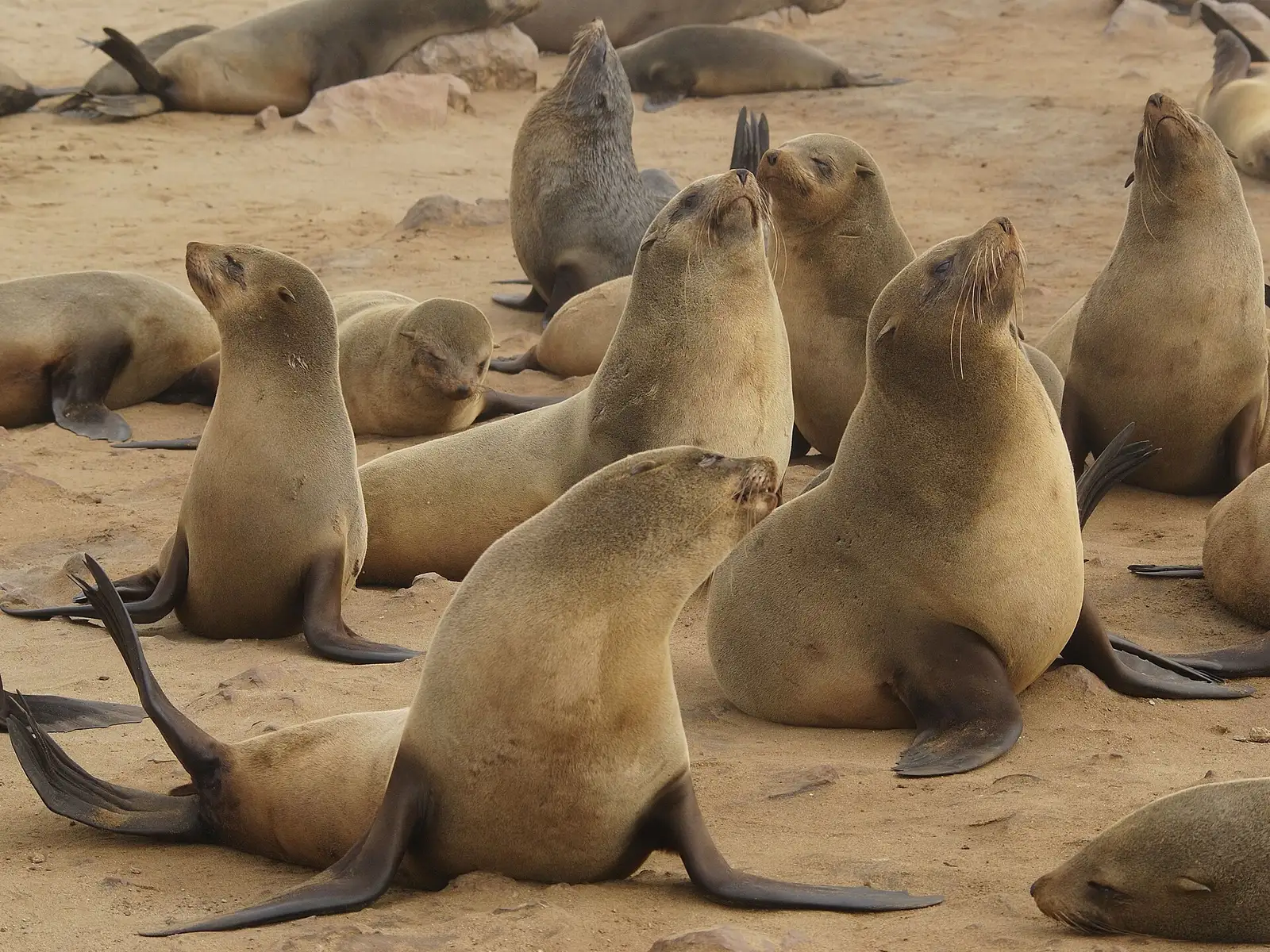
The Cape Cross seal colony is one of the largest Cape fur seal colonies in the world: estimates usually run from about 80,000 to 100,000 animals, with peak breeding-season counts of up to around 210,000. It lies about 125 km (roughly 1 h 30) north of Swakopmund on the Skeleton Coast. The road is tarred to Henties Bay and then a smooth salt road, so any car will do. Since 1 April 2026, foreign adults pay N$280 entry plus N$60 per car. Opening hours are 08:00–17:00 from mid-November to June, and 10:00–17:00 from July to mid-November.
This guide covers the drive, the stops on the way, seal seasons, fees, history and how to make the most of the visit.
Why visit Cape Cross?#
- The sheer scale. Seals cover the rocks and beach as far as you can see, and thousands more surf in the waves. It is noisy, chaotic and unforgettable.
- Seal pups. From late November there are pups everywhere, bleating like lambs.
- History. Cape Cross is where the Portuguese navigator Diogo Cão landed in 1486 and erected a stone cross, one of the first European markers on this coast.
- The drive. The road up the coast passes fishing spots, lichen plains and the photogenic Zeila shipwreck.
- It is easy. There are no 4x4 tracks or permits in advance; you pay at the reserve.
Getting to Cape Cross from Swakopmund#
| Leg | Approx. distance | Approx. time | Road |
|---|---|---|---|
| Swakopmund → Zeila wreck | 60 km | 45 min | Tar (C34) |
| Zeila wreck → Henties Bay | 14 km | 10 min | Tar |
| Henties Bay → Cape Cross | 60 km | 40–45 min | Salt road (C34) |
| Total, one way | approx. 125–130 km | about 1 h 30 |
The C34 runs north from Swakopmund along the coast. It was upgraded to tar as far as Henties Bay. North of Henties Bay, it becomes a “salt road”, a compacted mix of sand, gravel and salt that is usually smooth and fast. Take care, though:
- Salt roads get slippery when wet from fog or drizzle. Slow down in the mornings.
- Wind-blown sand can drift across the road in places.
- Fog can be thick in the early morning, and visibility can drop sharply.
- Keep to about 80 km/h on the salt road, and watch for anglers’ cars pulling on and off at the fishing spots.
Fuel: available in Swakopmund and Henties Bay. There is no fuel at Cape Cross.
Stops on the way#
The Zeila shipwreck#
About 14 km south of Henties Bay, a short sandy track leads from the C34 to the beach and the wreck of the Zeila. This fishing trawler ran aground in August 2008 after breaking loose from its tow while being taken away for scrap. It sits just offshore in the surf and is now covered in cormorants. It is one of the most photogenic and easily reached wrecks on the Skeleton Coast.
- Cost: free.
- Best light: early morning or late afternoon.
- Take care: do not drive onto soft sand in a 2WD, and do not leave anything visible in your car. Vendors sometimes sell crystals and souvenirs at the parking area. Buying is optional; be friendly but firm if you are not interested.
Henties Bay#
A small holiday and angling town about 75 km north of Swakopmund, at the mouth of the usually dry Omaruru River. It has fuel, supermarkets, cafés and seafood restaurants, so it is a good place for lunch on the way back. On weekends and holidays it fills up with anglers from Windhoek and South Africa. See our Henties Bay guide for where to eat and stay.
Fishing spots and lichen plains#
Along the coast you will see numbered fishing spots and signs to beaches. Inland, the gravel plains host some of Namibia’s richest lichen fields, with a signposted lichen area beside the road on the way to Cape Cross. Stay on the road, as tyre tracks scar the lichens for decades.
You will also pass roadside tables of salt crystals and minerals, some run as honesty stalls where you leave money in a tin. Buying is optional.
At the Cape Cross Seal Reserve#
Opening hours and fees#
| 16 November – 30 June | Daily 08:00–17:00 |
|---|---|
| 1 July – 15 November | Daily 10:00–17:00 |
| International adult (16+) | N$280 per day (from 1 April 2026) |
| SADC adult | N$180 |
| Namibian adult | N$60 |
| Children 9–15 | N$180 international, N$100 SADC, free for Namibians |
| Children 8 and under | Free |
| Vehicle (up to 10 seats) | N$60 |
Pay at the reception at the reserve entrance. These are the rates in the Government Gazette of 1 April 2026; older guides quoting N$80–150 are out of date. You can check the current tariff with MEFT or at the gate. Bring a card and some cash, in case the machine is down.
From the reception it is about 3 km to the car park beside the colony. Toilets are at the reception and at the small campsite halfway along, which also has picnic tables by the sea and is far enough from the colony to escape the smell. It is the best place to eat a packed lunch.
The walkway#
A raised walkway with a low wall runs alongside the colony, so you can watch and photograph seals just a few metres away without disturbing them. Seals look for shade, so they often lie right against the wall, under the walkway or even on it, and sometimes block the gate. Do not climb over, touch or feed them. Seals bite hard, and the bulls are big and aggressive in the breeding season. If one is in your way, wait or back off and let it move.
Allow 45 minutes to 1.5 hours at the colony. Most people find that is enough; the smell has a way of setting your schedule.
The smell and the noise#
Be prepared: the smell of tens of thousands of seals, fish and guano is overwhelming at first, and it is usually at its worst around January and February, when the bodies of pups that did not survive lie among the living. You also hear the colony before you see it, a constant roar of barking, coughing and bleating. Most visitors get used to it within ten minutes. The smell clings to clothes and hair, so wear something you do not mind washing.
Seal seasons: when to visit#
Cape fur seals live at Cape Cross all year, but the scene changes with the seasons:
| Period | What is happening |
|---|---|
| Mid-October – November | Big bulls arrive and fight for territory. They can weigh several times more than the females. |
| Mid-November – December | Pupping season. Most pups are born in this window, and the colony peaks at up to about 210,000 seals. |
| December – June | Lots of pups learning to swim, playing and calling for their mothers. A great time for photos. |
| July – October | Quieter, with fewer adults ashore; younger seals still around. Harvest season, with a 10:00 opening. |
Predators: watch for black-backed jackals patrolling the edges of the colony, especially in the pupping season. Brown hyenas also hunt here, though they are rarely seen by day. It is raw nature: weak and dead pups are part of the scene.
History: Diogo Cão and the stone cross#
In 1486, the Portuguese navigator Diogo Cão landed here on his second voyage down the African coast and erected a stone padrão (cross) to claim the land for Portugal. It was one of the first European landmarks in this part of Africa and gave the cape its name.
In 1893 the original cross was removed by the crew of a German warship and taken to Berlin. It is now held by the Deutsches Historisches Museum. A dark replica, which differed quite a lot from the original, was erected in its place on the Kaiser’s orders, and a lighter, more faithful copy was added nearly a century later. Both now stand side by side near the colony. A stone nearby carries an English translation of the Portuguese inscription, which records that King João II ordered Diogo Cão to discover this land and set up the pillar.
In the 1890s the area also had a short-lived guano-collecting settlement, with a police post, customs office and a railway line to carry the guano. It declined as the guano ran out and fresh water proved scarce. A small cemetery of simple wooden crosses near the reception is the main trace left. The reserve itself was proclaimed in the 1960s.
Photography tips#
- A zoom lens (100–300 mm) isolates individual seals, pups and jackals. A wide-angle lens shows the scale.
- Shoot along the wall at seal eye level for more intimate shots.
- Morning fog gives moody, soft light. Clear afternoons give sparkling surf but harsher light.
- Protect your gear from salt spray and sand, and wipe lenses afterwards.
- No drones. Flying is not allowed over the reserve; drones panic the animals.
Tours to Cape Cross#
If you do not have a car, Swakopmund operators run Cape Cross tours, usually combined with Henties Bay and the Zeila wreck, and sometimes with the lichen fields or a longer Skeleton Coast drive. Typical late-2026 prices per person:
| Operator | Length | Approx. price |
|---|---|---|
| Desert Explorers | about 4 hours | N$2,200 |
| Namibia Dream Safaris & Tours | about 5 hours (minimum 4 people) | N$2,500 (children 4–12 N$1,500) |
| Charly’s Desert Tours | about 4.5 hours | N$2,550 |
| Aquanaut Tours | about 6 hours | N$3,350 |
Check whether the park fee and lunch are included, and compare options in the booking widget on this page. Our tours and packages guide explains what to check.
After the colony, the bar at Cape Cross Lodge, close by on the coast, is a pleasant stop, with a small exhibition on the Skeleton Coast’s history.
Going further: Skeleton Coast, Messum and Brandberg#
From Cape Cross, the C34 continues north towards the Ugab River and the gates of the Skeleton Coast National Park, which has stricter entry rules. Our Skeleton Coast guide explains the permits and distances.
Inland lie the remote Messum Crater, reached on rough tracks and best visited by 4x4 with a guide, and the Brandberg, Namibia’s highest mountain with the famous White Lady rock painting. The Brandberg is reached via the C35 from Henties Bay towards Uis. Both are too far to add comfortably to a Cape Cross day trip and are best done with an overnight stay.
What to bring#
- A buff or scarf for the smell and the wind.
- Warm layers. The coast is often cold, foggy and windy, even in summer.
- Binoculars and a zoom lens.
- Water and snacks. Facilities at the reserve are limited.
- Cash and a card for fees, in case the machine is down.
- Clothes you can wash afterwards.
See the Swakopmund packing list for more.
Rules and responsible visiting#
- Stay behind the wall and on the walkway.
- Never touch, feed or approach seals, including lone seals you may find on beaches elsewhere. They bite and can carry disease.
- No pets in the reserve.
- Keep noise down. Shouting and sudden movements stress the animals.
- Stay on roads and tracks throughout the coastal parks.
- Take your rubbish with you.
Common mistakes#
- Arriving before 10:00 between July and mid-November and waiting at a closed gate.
- Budgeting with old fees. The April 2026 increase took foreign-adult entry from N$150 to N$280.
- Driving too fast on the salt road, especially when it is damp.
- Wearing your nicest jacket. The smell lingers.
- Leaving valuables in the car at the Zeila wreck parking area.
A suggested Cape Cross day#
| Time | Activity |
|---|---|
| 08:00 | Leave Swakopmund |
| 08:45 | Zeila shipwreck |
| 09:15 | Coffee in Henties Bay |
| 10:15 | Cape Cross seal colony and the stone crosses |
| 11:45 | Drive back south |
| 12:30 | Seafood lunch in Henties Bay |
| 14:30 | Back in Swakopmund |
From mid-November to June, when the reserve opens at 08:00, you can flip this around. Go straight to Cape Cross for the soft morning light, then stop at the Zeila wreck on the way back.
For more ideas around town, see our best day trips from Swakopmund and the best things to do in Swakopmund.
Photo gallery
Frequently asked questions
How far is Cape Cross from Swakopmund?
About 125 km north on the C34 coastal road, roughly 1 hour 30 minutes. The road is tarred to Henties Bay, then continues as a smooth salt road for the last 60 km or so.
What are the Cape Cross opening hours?
The reserve is open daily from 08:00 to 17:00 between 16 November and 30 June, and from 10:00 to 17:00 between 1 July and 15 November.
How much is the Cape Cross entrance fee in 2026?
Cape Cross is a top-tier reserve. Since 1 April 2026, international adults pay N$280 per day, SADC adults N$180 and Namibians N$60, plus N$60 per car. Foreign children aged 9–15 pay N$180, and children 8 and under are free. Pay at the reception at the reserve entrance.
When is the best time to see seal pups at Cape Cross?
Pups are born from about mid-November to December. Late November through to around June is good for seeing pups, while November and December offer the most drama, with bulls defending territories.
Does Cape Cross really smell that bad?
Yes. The smell of tens of thousands of seals is powerful and clings to clothes, and it is usually worst around January and February, when many pups die. Most visitors get used to it within ten minutes, but bring a scarf or buff and do not wear your favourite jacket.
Can I visit Cape Cross on a tour?
Yes. Swakopmund operators run Cape Cross tours, usually with the Zeila wreck and Henties Bay, for approx. N$2,200–3,350 per person in 2026 depending on length and group size. Check whether the N$280 park fee is included.
Can I combine Cape Cross with other sights?
Yes. The Zeila shipwreck south of Henties Bay is right on the way, and Henties Bay is a good lunch stop. Some travellers continue further north up the Skeleton Coast or inland to the Brandberg.