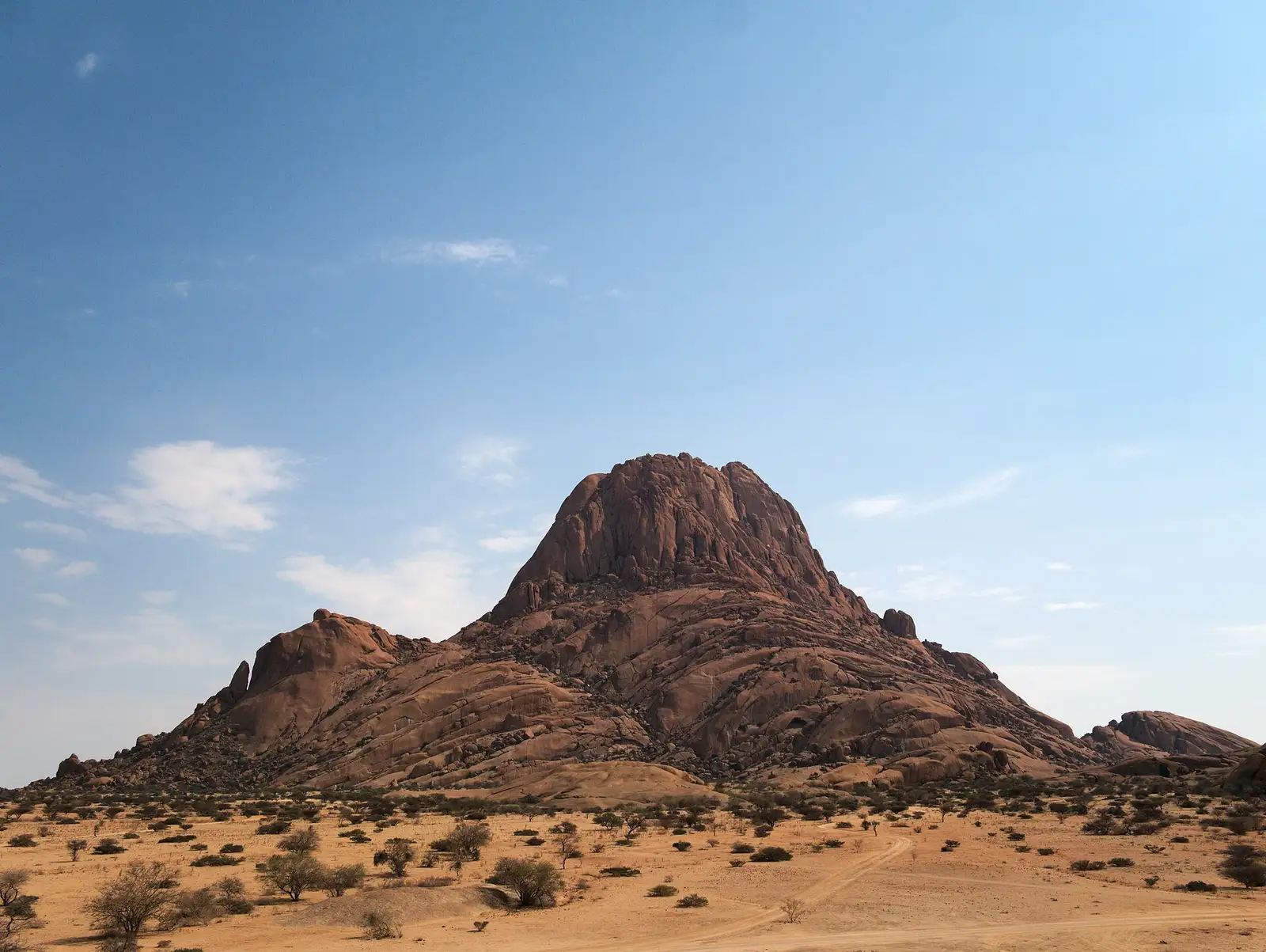
Spitzkoppe is a cluster of bare granite peaks rising about 700 m out of the flat Namib plains, roughly 150 km (about 2 hours) north-east of Swakopmund. It is often called the “Matterhorn of Namibia”. As a day trip, you get time for the famous Rock Arch, a guided walk to the Bushman’s Paradise rock paintings, boulder scrambling and huge desert views. Expect to pay approx. N$120–150 per adult to get in for the day, or about N$210–250 to camp. It is even better if you stay overnight for sunset and the stars.
This guide covers the route, fees, what to see, timings and what to bring.
Why visit Spitzkoppe?#
- The scenery. Smooth orange granite domes, balancing boulders and natural arches tower over a plain of grass and scattered shrubs. At sunset the rock glows red.
- Rock art. The San (Bushmen) left paintings in shelters around the mountains. Some are estimated at 2,000–4,000 years old.
- Walking and scrambling. There are endless boulders to explore, from easy walks to proper climbing, plus marked trails.
- Community benefit. The rest camp is run under a joint-venture lease with the local Spitzkoppe community in the ǂGaingu Conservancy, and your fees and guide payments support people who live in a tough, dry area.
- Stars. Far from any town, the night sky is extraordinary.
- Film history. Stanley Kubrick used Spitzkoppe landscapes as the backdrop for the “Dawn of Man” opening of 2001: A Space Odyssey.
Spitzkoppe in numbers#
| Gross (Great) Spitzkoppe | 1,728 m above sea level, rising about 700 m above the plain |
|---|---|
| Klein (Little) Spitzkoppe | about 1,560–1,580 m |
| Rock | Granite, more than 120 million years old |
| Nearest towns | Usakos and Arandis inland, Henties Bay on the coast |
| Distance from Swakopmund | approx. 150 km |
How to get to Spitzkoppe from Swakopmund#
The standard route is quick and mostly on tar:
- Leave Swakopmund on the B2 towards Arandis and Usakos. This is about 120 km on good tar.
- Turn left (north) onto the D1918 gravel road, signposted to Henties Bay and Spitzkoppe.
- After about 18 km, turn right onto the D3716 to Spitzkoppe.
- Continue for about 12 km to the community reception at the entrance.
Total: about 150 km, roughly 2 hours. You will see the peaks from a long way off.
Road conditions: the B2 is a fast highway. The D1918 is well-maintained gravel but can be badly corrugated in places. Drive at 60–80 km/h and slow down for sandy patches and bends. A normal car is fine. Inside the area, some tracks to the more remote campsites are sandy. Avoid those in a 2WD and stick to the main loop.
There is no fuel at Spitzkoppe. Fill up in Swakopmund. If you need a car, see our car rental guide.
Fees and the reception#
Spitzkoppe is not a national park, so national park permits do not apply. The campsite and gate are run by Spitzkoppe Rest Camp under a joint-venture lease with the local community (the arrangement dates from 2012), and the area lies in the ǂGaingu communal conservancy. At the reception you pay:
| Item | Approx. 2026 price |
|---|---|
| Day visit | approx. N$120–150 per adult, less for children (traveller reports; no tariff is published online) |
| Camping | approx. N$210–250 per person per night, entry included |
| Guided walk to Bushman’s Paradise / rock art | Paid to the community guide |
| Spitzkoppe Cabin Camp (bed, linen, private braai) | N$1,500 per person sharing, N$2,800 single (rates valid to 31 October 2026), entry included |
Fees are adjusted regularly, so treat these as a guide. Bring cash in case the card machine is not working. You also get a map of the area and the campsites at reception.
What to see and do at Spitzkoppe#
The Rock Arch#
A natural granite arch that frames the surrounding peaks. It is smaller than photos suggest but one of the most photographed rocks in Namibia. The easiest approach is from near campsite 5; you then scramble up a steep but grippy slab. For the classic shot of someone standing under the arch, the photographer stays on the rocks opposite.
- Best light: sunrise, when the arch glows orange, or shoot it in silhouette against the sunset or the Milky Way at night.
- Campers: avoid the sites right next to the arch unless you want night shots of it; there is a steady stream of visitors past your tent.
- Watch your step: the granite is grippy but steep, and it gets slippery with loose sand. Wear proper shoes.
Bushman’s Paradise#
In the Pontok Mountains, the cluster of domes beside the main peak, a steep granite slope leads up to a hidden, green bowl. Rock paintings shelter under an overhang there. A fixed chain helps you up the steepest part of the slab.
The paintings here are estimated to be several thousand years old. Sadly, many were badly damaged by vandalism in the past, which is why visits are now guided. Allow 1–2 hours for the guided walk.
Rhino painting and other rock art#
Rock paintings are scattered around the base of Gross Spitzkoppe. One well-known site shows a rhino, a reminder that the animals once roamed this area. Ask at reception which sites the guides currently visit.
Boulders, viewpoints and trails#
Around the main peak are dozens of smaller arches, overhangs and boulder piles. Wander, scramble and find your own viewpoint. Sunset from any high boulder facing the main peak is unforgettable.
If you want a proper walk, there are marked self-guided trails: a 10 km walking and running loop and a longer 24 km route that is also open to mountain bikes, plus 35 km and 65 km mountain-bike routes. Longer guided hikes around the massif (around 6–8 hours) can be arranged at reception. Start early and carry far more water than you think you need.
Watch for rock hyraxes (dassies), klipspringers and Namib rock agamas on the boulders, and hornbills and starlings around camp.
Climbing#
Gross Spitzkoppe is a serious technical climb, not a hike. Only a few hundred parties have ever reached the top; the first recorded ascent was by climbers from Cape Town in 1946. The heat makes climbing impractical in summer. If you are an experienced climber, bring your own gear and arrange a local climbing guide well in advance. Everyone else should stick to walking and easy scrambling.
Day trip timings#
Classic day trip#
| Time | Activity |
|---|---|
| 07:00 | Leave Swakopmund (fill up with fuel first) |
| 09:00 | Arrive and pay at reception |
| 09:30 | Guided walk to Bushman’s Paradise |
| 11:30 | Rock Arch and boulder scrambling |
| 13:00 | Picnic lunch in the shade of a boulder |
| 14:00 | Drive round the peaks and explore viewpoints |
| 15:30 | Leave Spitzkoppe |
| 17:30 | Back in Swakopmund |
Overnight (recommended)#
Leave Swakopmund after lunch, arrive mid-afternoon, set up camp, and climb a boulder for sunset. Have a braai under the stars, then do the guided rock-art walk early the next morning before the heat. You will be back in Swakopmund by early afternoon.
Camping and staying overnight#
The Spitzkoppe Rest Camp campsite is one of the most beautiful in Namibia. Sites are spread out among the boulders, often far apart, each with a braai place, a long-drop toilet and a rubbish drum, but no water or electricity. Water taps, toilets and showers are at the main reception area, which can be a couple of kilometres from the remote sites. Sites have traditionally been allocated first come, first served, so arrive early in the afternoon for the best choice.
- Book or arrive early in peak periods (South African and Namibian school holidays, Easter and December).
- Bring everything: food, drinking water, a torch and warm clothes. Nights can be cold, especially in winter.
- Firewood: buy it at reception; collecting wood is not allowed.
- Wind: strong winds can blow in from the coast at night. Pitch tents with the door away from the wind, close everything up and put your fire out completely before bed.
- Keep valuables locked away and do not leave camp unattended for long.
For more comfort, Spitzkoppe Cabin Camp has 12 simple cabins with real beds, linen, private fire pits and shared hot showers (N$1,500 per person sharing until 31 October 2026). Spitzkoppen Lodge offers upmarket chalets near the mountains; it is for staying guests only, with no day visitors or campers allowed in.
Tours from Swakopmund#
If you do not have a car, several Swakopmund operators run Spitzkoppe day tours and overnight camping trips. Day tours typically include transport, entry fees, a guided walk and lunch. In late 2026, published day-tour prices range from about N$3,250 per adult (an 8-hour tour with Desert Dunes and Dust) to N$4,150 (a 10-hour extended tour with Namibia Dream Safaris), with child discounts. Compare options in the booking widget on this page, or ask your hostel whether anyone is organising a shared trip. Our tours and packages guide explains what to look for.
Best time to visit Spitzkoppe#
- May to September (winter): the best months. Days are warm and pleasant, but nights can drop close to freezing, so bring a proper sleeping bag.
- October to April (summer): midday temperatures can be fierce inland, often well above 35°C. Walk early, rest at midday and go out again late afternoon. Occasional summer thunderstorms bring spectacular skies.
- Time of day: early morning and late afternoon for walking and photos. Midday light is harsh and the rock gets hot.
- Moon phase: for star photography, pick nights near the new moon.
The coast is often foggy and cool while Spitzkoppe is hot and sunny. Our Swakopmund weather guide explains the difference, and the best time to visit Namibia covers the inland seasons. Spitzkoppe is also a natural stop between the coast and Damaraland or Etosha on a Namibia road trip.
What to bring#
- Water: at least 3 litres per person for a day visit, more if camping.
- Food: there is very little on site, so bring a packed lunch and snacks.
- Hat, sunscreen, sunglasses.
- Proper shoes with good grip for the granite slabs.
- Cash for fees, guides and tips.
- A warm jacket for evenings and early mornings.
- Torch or headlamp if staying overnight.
- Rubbish bag: take everything back with you.
Our Swakopmund packing list has the full checklist.
Safety and responsible travel#
- Never touch the rock paintings, and do not wet them for photos. Oils and water damage them permanently.
- Scramble within your ability. The granite is easy to go up and harder to come down. Rescue is a long way off.
- Tell someone your plans if walking away from the main area, and carry water.
- Respect the community. Pay fees, use local guides, and buy crafts or drinks from local sellers if you can.
- Do not leave valuables visible in the car while walking.
- Drive carefully on gravel on the way home, especially in late-afternoon glare.
See is Swakopmund safe? for general safety advice in the region.
Photography tips#
Spitzkoppe is one of the most rewarding places in Namibia for photographers, but the light is everything.
- Golden hour is short. The rock goes from orange to deep red in the last 30–40 minutes before sunset. Be in position early, especially if you have to scramble up a boulder.
- Sunrise is quieter. Most day visitors arrive mid-morning, so the early light is the best time for crowd-free shots of the Rock Arch.
- Use people for scale. The domes are so smooth that it is hard to judge their size. A person standing on a ridge or in the arch makes the photo.
- Night skies. With almost no light pollution, the Milky Way is spectacular, especially in the cooler months. Bring a tripod and a head torch with a red-light mode so you do not ruin everyone else’s night vision.
- Midday is for detail. Harsh overhead light suits close-ups of textures, lichens and plants better than wide landscapes.
- Protect your gear. Wind blows fine sand around, so change lenses inside the car or a bag.
If you fly a drone, ask at reception first. Do not fly near other campers, rock-art sites or wildlife.
Common mistakes#
- Arriving at midday in summer and trying to walk in 38°C heat.
- Not bringing cash for fees and guides.
- Running out of water, as there are no shops.
- Underestimating the drive. Two hours each way is four hours of driving in a day, and gravel driving in the late afternoon sun is tiring.
- Driving into soft sand on side tracks in a 2WD rental.
Spitzkoppe vs other day trips#
Spitzkoppe is the most rewarding inland landscape within reach of Swakopmund. If you want desert scenery closer to town, try the Moon Landscape and Welwitschia Drive. If you want wildlife, head to Walvis Bay or Cape Cross. See all the options in our best day trips from Swakopmund guide.
Photo gallery
Frequently asked questions
How far is Spitzkoppe from Swakopmund?
About 150 km, which takes roughly 2 hours. Most of the route is on the tarred B2 towards Usakos, followed by about 30 km of gravel on the D1918 and D3716.
Can you do Spitzkoppe as a day trip from Swakopmund?
Yes, it is about 4 hours of driving in total, leaving 3–5 hours at the site. Many people find it even better as an overnight trip, because sunset and sunrise light on the granite is spectacular.
How much does it cost to visit Spitzkoppe?
There is no published 2026 tariff, but recent visitors report a day fee of about N$120–150 per adult and camping at about N$210–250 per person per night including entry. Rock-art guides are paid separately. Fees change, so bring cash and confirm at reception.
How much is a Spitzkoppe tour from Swakopmund?
Guided day tours from Swakopmund cost approx. N$3,250–4,150 per adult in 2026, usually including transport, entry, a guided walk and lunch. For two or more people, a rental car plus fees is much cheaper.
Do I need a 4x4 for Spitzkoppe?
No. The gravel access roads are fine for a normal car with sensible clearance if you drive slowly. Some internal tracks around the campsites are sandy, so stick to the firm ones in a 2WD.
Can you climb Spitzkoppe?
Not as a hike. Reaching the summit of Gross Spitzkoppe is a serious technical rock climb that needs experience, equipment and usually a guide. Visitors can scramble on the lower boulders and walk to the Rock Arch and rock-art sites.
Is there food and fuel at Spitzkoppe?
There is no fuel. The rest camp reception has toilets and water taps, and a small restaurant there has served meals ordered on arrival, but do not count on it: bring your food and plenty of water from Swakopmund, and buy firewood at reception. Fill up before you leave the coast.