The Moon Landscape and Welwitschia Drive is the best self-drive day trip from Swakopmund. It is a loop of about 150–160 km on gravel roads through the Namib-Naukluft Park, marked by 13 numbered beacons. The route takes in lichen fields, the eroded Moon Landscape, the green Goanikontes oasis and the Welwitschia Plains, where some plants are well over 1,000 years old. You need a permit bought in Swakopmund before you go, which costs N$280 per foreign adult plus N$60 per car since 1 April 2026. A normal car is fine.
This guide covers the permit, the route beacon by beacon, timings, and what to bring.
Why do the Welwitschia Drive?#
- It is cheap and independent. For two to four people with a rental car, it costs little more than the permit and fuel.
- It shows you the “other” Namib. Instead of red dunes, this is a stark gravel desert of granite, black dolerite ridges and canyons, closer to what most of the Namib actually looks like. Our Namib Desert guide explains how the sand sea and the gravel plains fit together.
- Welwitschias. Welwitschia mirabilis grows only in the Namib Desert of Namibia and southern Angola, and it is one of the strangest plants on Earth.
- It is close. The first beacon is about 30 minutes from town, and you can be back by mid-afternoon.
The permit: cost, where to buy it and opening hours#
The Welwitschia Drive lies inside the Namib-Naukluft National Park, so you need a park permit. There is no gate or pay point on the route, so you must buy it before you leave Swakopmund.
| Where | MEFT office, the yellow building on the corner of Bismarck Street and Sam Nujoma Avenue, central Swakopmund |
|---|---|
| Hours | Mon–Fri 08:00–13:00 and 14:00–17:00. Weekends and public holidays 08:00–13:00 |
| Adults 16+ (from 1 April 2026) | N$280 international, N$180 SADC, N$60 Namibian |
| Children 9–15 | N$180 international, N$100 SADC, free for Namibians |
| Children 8 and under | Free |
| Vehicle | N$60 per car with up to 10 seats |
| Payment | Card or cash; bring cash in case the machine is down |
| You get | A permit plus a paper map with the numbered beacons and notes |
Rangers do not check permits often, but driving in a national park without one is an offence, and the fees fund conservation. Just buy it.
Route overview#
From Swakopmund, take the B2 east towards Windhoek and turn right onto the C28 gravel road just outside town. After a few kilometres, turn left onto the signposted D1991 / Welwitschia Drive. Beacon 1 is near here, and the numbered beacons then guide you east into the park.
Approximate distances from Swakopmund town centre:
| Stop | Approx. distance | Approx. drive time |
|---|---|---|
| Beacon 1 (start of Welwitschia Drive) | 20 km | 25 min |
| Moon Landscape viewpoints | 35 km | 40 min |
| Goanikontes oasis | 40 km | 50 min |
| Welwitschia Plains (beacon 12) | 65–70 km | 1 h 15–1 h 30 |
| Full loop back to town | 150–160 km in total | 4–5 h with stops |
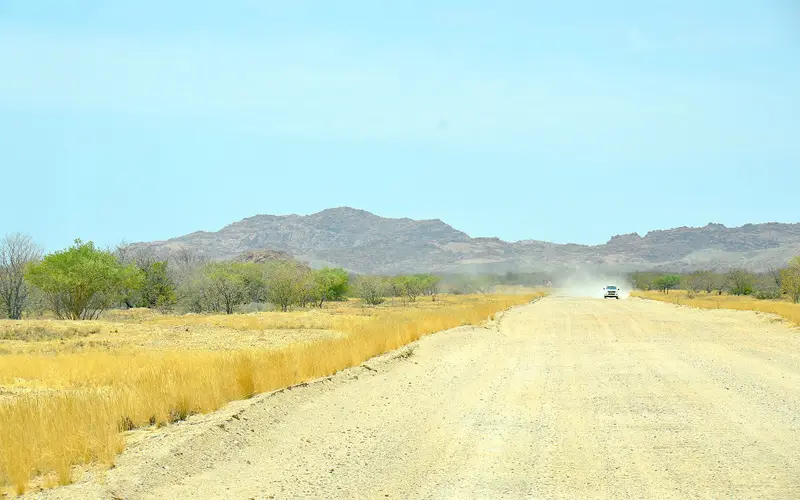
Gravel roads vary. Some sections are smooth and others are stony, corrugated or steep and winding where they drop into valleys. Plan on 40–60 km/h, and slower on rocky stretches.
The beacons: what you will see#
The route is marked with stone beacons numbered 1 to 13. Your permit map explains each one. These are the highlights.
Beacons 1–3: lichen fields and dollar bushes#
The gravel plains just inland from the coast are covered in lichens, some of which look like dead twigs until the morning fog rolls in. Then they swell and turn green, grey and orange. They survive entirely on fog moisture, grow extremely slowly and are destroyed by a single set of tyre tracks or footsteps.
You will also see dollar bushes, named for their round, coin-like succulent leaves.
Beacons 4 and 6: the Moon Landscape#
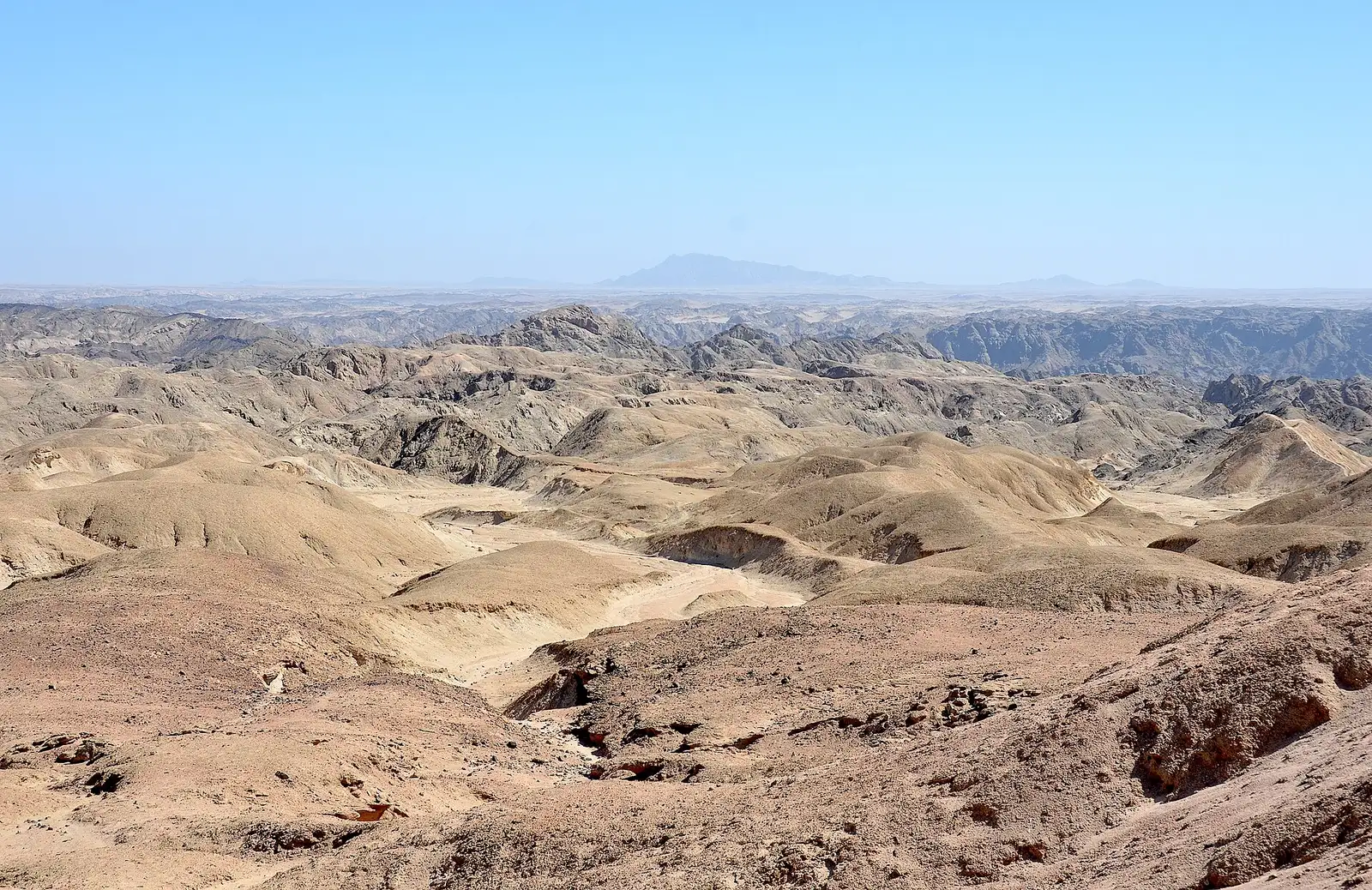
This is the scene everyone comes for. Over millions of years, the Swakop River and its tributaries cut deep into the soft rock, leaving a maze of bare ridges and gullies stretching to the horizon. It really does look lunar.
- Best light: early morning or the last two hours before sunset, when shadows give the ridges shape. At midday it can look flat and washed out.
- Viewpoints: there are several pull-offs. Walk a few metres along the ridge for the classic view, but stay on the obvious paths.
Goanikontes oasis (detour)#
From the Moon Landscape, a steep, winding road descends into the Swakop River valley to Goanikontes, a green oasis of palms, lawns and big shady trees. It was a vegetable-growing farm in the early 20th century. Today it is a rest camp with:
- A restaurant serving breakfast and lunch, with cold drinks.
- A pool.
- Shaded campsites with braai places. Booking is required.
It is the only place on the whole route with services, so it is the natural lunch stop. Opening hours and prices change, so call ahead if you are counting on a meal.
Beacons 7–10: Swakop River and the dolerite dyke#
East of the Moon Landscape, the route passes traces of old wagon tracks and then a striking black dolerite dyke. This is a wall of dark igneous rock that was forced as molten magma into cracks in the pale granite. Because it erodes more slowly, it now stands out as a long black ridge.
Near beacons 9–10 there are official campsites in the Swakop riverbed. They have no water, no facilities and no mobile signal. Camp only at designated sites; wild camping in the park can lead to a fine.
Beacons 11–12: the Welwitschia Plains#
The final section crosses a wide gravel plain dotted with welwitschias. At beacon 12, a fenced enclosure and a small viewing platform protect the “Big Welwitschia”, the largest plant on the route. The information board puts it at about 1,500 years old. Exact ages are hard to measure, but the biggest plants are certainly centuries old. Boards along this stretch also explain the plant’s biology, including a diagram of its surprisingly extensive root system.
Why welwitschias are so strange:
- Each plant only ever grows two leaves. They keep growing from the base for the plant’s entire life, then split and fray in the wind into the tangled mass you see. The woody stem is mostly hidden underground.
- Plants are either male or female. Female cones are larger and rounder, while male cones are smaller and elongated. The information boards give January to March as the main cone (flowering) season, when you may see insects moving pollen between plants.
- They survive on fog, dew and deep roots in one of the driest places on Earth, and grow extremely slowly.
- The plant is named after the Austrian botanist Friedrich Welwitsch, who came across it in southern Angola in 1859. It appears on Namibia’s coat of arms, is strictly protected and is listed under CITES.
Return to Swakopmund#
From the Welwitschia Plains you head back to the C28 and drive west to Swakopmund. The final stretch is on gravel, then tar for the last few kilometres into town. Heading east instead, the C28 is the scenic gravel route to Windhoek over the Bosua Pass; our Windhoek to Swakopmund guide compares it with the tarred B2.
Suggested timings#
Full loop (4–5 hours)#
| Time | Stop |
|---|---|
| 07:30 | Leave Swakopmund with your permit (bought the day before) |
| 08:00 | Lichen fields, hopefully in the fog |
| 08:45 | Moon Landscape viewpoints in the morning light |
| 09:30 | Coffee at Goanikontes |
| 10:30 | Dolerite dyke and Swakop riverbed |
| 11:30 | Welwitschia Plains and the Big Welwitschia |
| 13:00 | Back in Swakopmund for lunch |
Short version (2–3 hours)#
Drive to the Moon Landscape, descend to Goanikontes for lunch and return the same way. It is ideal in the late afternoon for sunset light, but make sure you are back on tar by dark.
Vehicle and driving tips#
- A normal car works. Most rental hatchbacks and sedans manage if driven slowly, but a vehicle with higher clearance is more comfortable on rocky sections. See our car rental guide.
- Fill up in Swakopmund. There is no fuel on the route.
- Check the spare tyre and jack before you leave. Sharp stones cause punctures.
- Watch for mine traffic. Parts of the area are used by large mines, and you may meet heavy trucks or construction. Give them space.
- Do not drive off the tracks. Old tyre scars on the gravel plains are still visible decades later.
- Download offline maps. Mobile signal disappears soon after leaving town.
- Avoid east-wind days. On the few days a year when the hot east wind blows, the inland desert is dusty and uncomfortable.
What to bring#
- At least 2 litres of water per person, plus extra in the car.
- Snacks or a packed lunch, unless you are eating at Goanikontes.
- Hat, sunscreen and sunglasses. It can be 10–15°C warmer inland than on the foggy coast.
- A warm layer for the early-morning fog near the coast.
- Binoculars and a camera.
- Your permit, kept in the car.
- Wet wipes for the dust.
The Swakopmund packing list has more ideas.
Guided tour alternatives#
If you do not have a car, several Swakopmund operators offer Moon Landscape and Welwitschia tours, sometimes combined with Goanikontes. Guides bring the geology and botany alive and take care of the permit. Typical late-2026 prices:
| Tour | Duration | Approx. price per adult |
|---|---|---|
| Half-day Moon Landscape / Welwitschia tour (Desert Explorers, Charly’s Desert Tours; morning or 14:00) | about 4 hours | N$1,100 (children about N$550) |
| Full-day Welwitschia tour (Charly’s, minimum 4 people) | about 8 hours | N$2,100 |
| Welwitschia, Goanikontes and Moon Landscape drive (Desert Dunes and Dust) | about 4.5 hours | N$2,535 |
Compare options in the booking widget on this page or ask your hostel. A half-day tour for one person costs about the same as a day’s car hire, but for two or more people, a rental car plus permits is cheaper.
The Living Desert tour is a different but complementary half-day trip. It covers the coastal dunes just outside town and focuses on reptiles and insects rather than plants and landscapes.
Common mistakes#
- Driving out without a permit. You cannot buy one on the route.
- Leaving it too late on a weekend. The office closes at 13:00 on Saturdays, Sundays and public holidays.
- Visiting the Moon Landscape at noon. The light is flat; go early or late.
- Speeding on gravel. Loose stones on bends are the main cause of rollovers in Namibia.
- Walking on the lichen fields or close to welwitschias. Damage lasts for decades.
- Not carrying enough water. If you break down, it can be hours before another car passes.
Combining the drive with other trips#
- With Spitzkoppe: too much for one day. Do them on separate days. See the Spitzkoppe day trip guide.
- On a longer road trip: if you are driving between Sossusvlei and Swakopmund, the Welwitschia Plains fit well into a day on the coast; see our Namibia road trip itinerary.
- With sandboarding or quad biking: a morning Welwitschia Drive and an afternoon in the dunes works well. See our adventure activities guide.
- With a free town afternoon: the Mole, the jetty at sunset and a historical walk are all free.
For the full list of options, see the best day trips from Swakopmund.
Photo gallery
Frequently asked questions
Do you need a permit for the Welwitschia Drive?
Yes. The Welwitschia Drive runs through the Namib-Naukluft National Park, and a permit must be bought in advance at the MEFT office on the corner of Bismarck Street and Sam Nujoma Avenue in Swakopmund. There is no gate on the route where you can pay.
How much is the Welwitschia Drive permit in 2026?
Since 1 April 2026 it costs N$280 per foreign adult and N$60 per car with up to 10 seats. SADC adults pay N$180 and Namibians N$60; foreign children aged 9–15 pay N$180, and children 8 and under are free.
Can I do the Welwitschia Drive in a normal car?
Yes. The roads are gravel and some sections are rocky and corrugated, but a normal 2WD car with reasonable ground clearance manages if you drive slowly. Check your spare tyre before you go.
How long does the Moon Landscape drive take?
Allow 4–5 hours for the full Welwitschia Drive loop of about 150–160 km, including stops and lunch at Goanikontes. Just the Moon Landscape and Goanikontes takes about 2–3 hours.
How old is the giant welwitschia?
The information board at the Big Welwitschia gives an age of about 1,500 years. Age estimates for welwitschias are uncertain because the plant has no annual growth rings, but the biggest specimens are certainly many centuries old.
Is the office open on weekends to buy the permit?
The MEFT office in Swakopmund has been open Monday to Friday 08:00–13:00 and 14:00–17:00, and 08:00–13:00 on weekends and public holidays. Hours can change, so buy your permit the day before if you can.
Can I do the Moon Landscape without a car?
Yes. Several Swakopmund operators run guided Moon Landscape and Welwitschia tours that include the permit, from about N$1,100 per adult for a half day to N$2,100–2,550 for longer or full-day tours in 2026.