Sandboarding in Swakopmund means a half-day trip to the dune belt just outside town, where you either ride a snowboard standing up or race head-first down the slopes on a thin board. In 2026 a morning with Alter Action, the original operator, costs N$700 for lie-down and N$800 for stand-up, including pickup, gear, a light lunch, drinks and a video of your runs. No experience is needed for lie-down, and it is one of the most fun, best-value adventures on the Namibian coast.
Why sandboard in Swakopmund?#
The Namib is often called the oldest desert on earth, and the dune belt between Swakopmund and Walvis Bay rises straight out of the coastal plain. These are tall, steep, wind-shaped dunes with clean slip faces, which is exactly what sandboarding needs. You are on the sand within minutes of leaving town, and the cool coastal air means you are not cooking in 40°C heat as you would further inland.
Swakopmund has also had organised sandboarding for decades, so the operators know which dune faces work in which wind, how to teach complete beginners, and how to keep a group moving. If you are only going to sandboard once in your life, this is a very good place to do it.
Stand-up vs lie-down sandboarding#
The first decision is which style to book. They are quite different experiences.
| Lie-down | Stand-up | |
|---|---|---|
| What you ride | Thin, waxed board (similar to a sheet of hardboard) | Snowboard with soft boots and bindings |
| Skill needed | None | Easier if you snowboard, surf or skate |
| Speed | Very fast on steep runs (up to roughly 70–80 km/h) | Slower, more controlled carving |
| Learning curve | Five minutes | Most of the morning for first-timers |
| Typical price (approx. 2026) | N$700 | N$800 |
| Best for | Thrill-seekers, groups, nervous first-timers | Snowboarders, people who want to learn a skill |
Lie-down boarding#
You lie on your stomach on a waxed board, hold the front edge up, and steer and brake with your feet dragging behind you. Guides usually start you on a short slope, then move to bigger and steeper faces. Some runs end with a small lip or bump that sends you briefly airborne. It is fast, silly and very sociable, and almost everybody comes back grinning.
Stand-up boarding#
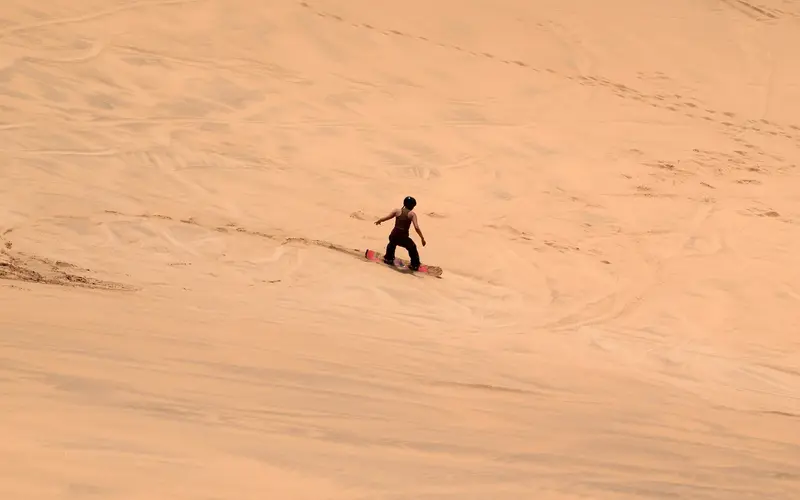
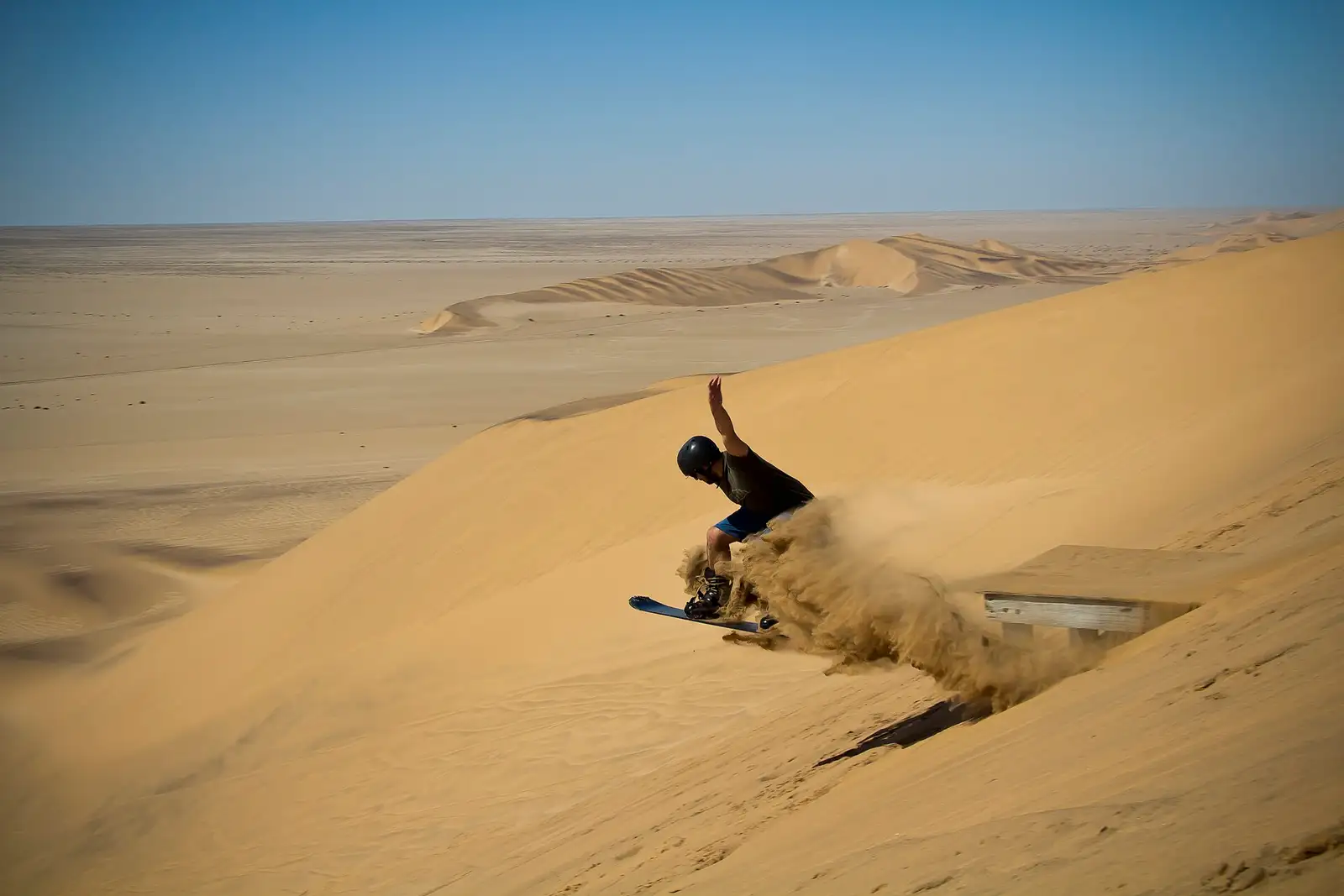
Stand-up boarding uses real snowboards, soft boots and bindings, and you ride the slip faces in the same way you would ride powder. Sand is slower and grabbier than snow, so you need to commit to your turns and keep your weight slightly back. If you already snowboard you will be carving within a few runs. If you have never been on a board, expect to spend a fair bit of time falling over before it clicks, which is part of the fun on soft sand.
Where you go#
Trips run to the coastal dune belt just south and east of town, part of the Dorob National Park. Alter Action, the longest-established operator, uses a large star dune roughly 11 km from Swakopmund by road. Star dunes have several faces, so guides can pick the side that suits the day’s wind and sun.
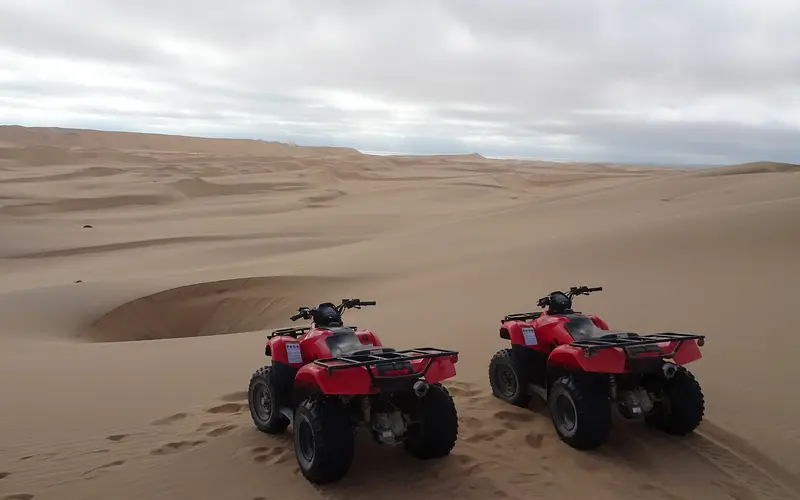
Combo trips with quads use the dune belt towards Long Beach (Langstrand), roughly halfway between Swakopmund and Walvis Bay. If you are staying in Walvis Bay, Dune 7 is the famous big dune on that side and some people carry a board up it, although organised sandboarding happens closer to Swakopmund.
Sandboarding operators in Swakopmund#
Prices below are approximate for 2026 and are subject to change. Always confirm what is included when you book.
Alter Action Sandboarding#
The original Swakopmund sandboarding operator and still the name most people mention. Alter Action runs a trip every day, leaving town at 09:30 and returning around 13:30. You can be collected from your accommodation or meet at the Far Out booking office, 25 Moses Garoeb Street (at Amanpuri Travellers Lodge).
- Price (2026): N$700 lie-down, N$800 stand-up; lie-down for children aged 5–8 is about N$350 through booking agents
- Included: transport to the dune, helmet, elbow pads and gloves, instruction, boards, boots for stand-up riders, board wax, a light lunch (sandwich fixings, with vegetarian and lactose-free options), water, soft drinks and a Tafel Lager, and a video of your runs
- Payment: Namibian dollars, rand, US dollars, pounds and euros in cash, plus Visa and Mastercard with no card surcharge
Desert Explorers#
Desert Explorers runs one of the big adventure centres in town. It sells the half-day lie-down (N$700) and stand-up (N$800) trips at the same 09:30 time, but its real strength is combos with quad bikes:
- 2-hour combo: one hour of lie-down sandboarding plus one hour on a quad, about N$890
- 3-hour combo: one hour of lie-down sandboarding plus two hours on a quad, about N$1,100
- Explorer Combo: quad riding, lie-down boarding and a slower nature section looking for desert wildlife (price on request)
Pickup from Swakopmund accommodation is included. Online booking is closed for most activities in July–August, so email or phone then.
What a typical sandboarding morning looks like#
- Pickup (around 09:00–09:30). A 4x4 or minibus collects you from your accommodation or a central booking office.
- Gear-up at the dune. You get your helmet, pads and gloves, stand-up riders are fitted with boots and boards, and the guides explain how to steer and stop.
- Warm-up runs. Short, gentle slopes first. Lie-down riders learn to lift the nose and brake with their toes; stand-up riders learn heel and toe edges.
- Big runs. As confidence grows, the guides move the group to longer and steeper faces. Lie-down riders often get timed or speed-measured on the fastest run.
- Lunch and drinks on the dune. Usually a simple sandwich lunch with soft drinks or a beer.
- Back in town (about 13:30). Enough time to shower off the sand, grab a coffee and do something else in the afternoon.
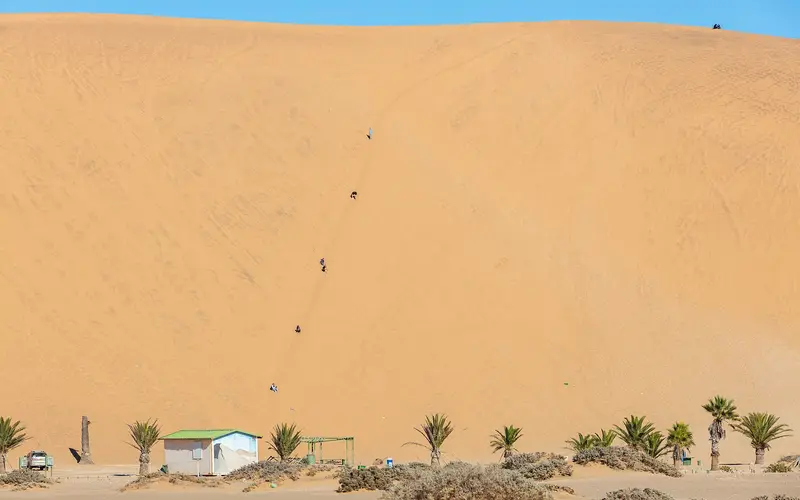
The only real effort is walking back up. There are no lifts, and climbing a soft dune face is hard work. Most people manage somewhere between eight and fifteen runs in a morning, depending on fitness and how long the runs are.
Costs at a glance#
| Option | Approx. price per person (2026) |
|---|---|
| Lie-down sandboarding, half day | N$700 |
| Stand-up sandboarding, half day | N$800 |
| Lie-down for children aged 5–8 | approx. N$350 |
| Sandboarding + quad combo, 2 hours | approx. N$890 |
| Sandboarding + quad combo, 3 hours | approx. N$1,100 |
| Video of your runs | Included with the half-day trip |
Prices change every season, so treat these as a guide rather than a quote. The 2-hour combo gives you only one hour on the sand, so if sandboarding is what you are really after, the half-day trip is better value. For the bigger picture on what activities cost, see our Swakopmund budget travel guide.
Best time to go sandboarding#
Time of day: Trips run in the morning, and that is when you want to go. The sand is firmer and cooler, the light is soft and the wind is usually lighter. Morning fog is common on the coast, but it tends to thin quickly a few kilometres inland where the dunes are, and it does not stop the trip.
Season: Sandboarding runs year-round. Summer (roughly December to March) is warmer and busier. Winter (June to August) brings occasional hot, dusty east-wind days; on those days the sand blows hard and trips may be adjusted. Read more in our Swakopmund weather guide, or the best time to visit Namibia if you are planning a longer trip.
Booking: In peak periods (July–August and the December–January holidays) book a few days ahead. The rest of the year, a day’s notice is often enough.
What to wear and bring#
- Closed shoes for lie-down boarding. You use your feet to brake, and sand in sandals hurts.
- Socks for stand-up boarding (boots are supplied).
- Clothes you do not mind ruining with sand. Long sleeves and trousers are not required, but they reduce sand rash on the fastest lie-down runs.
- Windbreaker or fleece. Coastal mornings can be grey and chilly.
- Sunglasses and sunscreen. The sun is strong even when it feels cool.
- Cameras and phones in a zip-lock bag or sand-proof case, carried in a small backpack. Fine sand gets into everything.
- Water if you drink a lot; operators provide drinks but climbing dunes is thirsty work.
- Cash for a tip for the guides. Card payment is accepted for the trip itself, but tips are usually given in cash; see our guide to money in Namibia.
Our full Swakopmund packing list covers the rest.
Safety tips#
- Keep your mouth shut on lie-down runs. Seriously. Keep your chin up and your lips closed.
- Brake with both feet evenly. Dragging one foot harder than the other turns you sideways, which is how most wipe-outs happen.
- Wait for the guide’s signal before each run so the landing zone is clear.
- Wear the helmet and pads you are given, even if they look uncool on the video.
- Know your limits on stand-up. Fatigue causes most falls; take a break before your legs give up.
- Stay on the operator’s dunes. The dune belt is part of a national park with sensitive areas. Licensed operators know where riding is allowed.
Common mistakes#
- Booking stand-up as a total beginner with only one morning. You may spend most of it learning. Lie-down is more fun if you only have one shot.
- Wearing sandals or going barefoot for lie-down. You need shoes to brake.
- Bringing an unprotected phone or camera. Sand gets into ports and lenses within minutes.
- Under-estimating the climb. Pace yourself on the first few runs so you have energy for the big ones.
- Leaving it to the last day. Fog, wind or a full minibus can push you to another day, so book it early in your stay.
Combining sandboarding with other activities#
Because sandboarding finishes around lunchtime, it pairs well with an afternoon activity:
- Skydiving: Tandem jumps usually run later in the day once any fog has lifted. See our skydiving in Swakopmund guide.
- Quad biking: Book a combo, or an afternoon ride separately (from N$590 for an hour). See quad biking in Swakopmund.
- Something gentler: A walk out on the jetty, coffee in town, or the history and architecture walk.
If you want a full plan, our 3 days in Swakopmund itinerary slots sandboarding into the first morning, and the adventure activities guide compares all the adrenaline options side by side.
Is sandboarding suitable for children?#
Generally yes, especially lie-down boarding, provided children can manage the walk back up the dune. Booking agents list a reduced lie-down rate for children aged 5–8 (about N$350), so primary-school children are clearly welcome; ask when booking about anyone younger. Families who want something calmer can combine a short sandboarding session with the Living Desert tour, which is great for curious children.
How to book#
You can book in three ways:
- Directly with the operator by phone, email or their website. This is usually the simplest and gives you the clearest picture of what is included.
- Through your hostel, guesthouse or a booking office in town. Most accommodation in Swakopmund books activities for guests and can arrange pickups.
- Online through booking platforms, useful if you want instant confirmation before you arrive.
If you are planning a whole trip around activities, our Swakopmund tours and packages guide explains which combos are good value. For the full list of what else to do in town, see the best things to do in Swakopmund.
Photo gallery
Frequently asked questions
Is sandboarding in Swakopmund safe for beginners?
Yes. Lie-down boarding needs no experience at all and guides start you on shorter, gentler slopes before moving to the big runs. Stand-up boarding is harder if you have never snowboarded, but the soft sand makes falls far less painful than on snow.
How much does sandboarding cost in Swakopmund?
Alter Action, the best-known operator, charges N$700 for lie-down and N$800 for stand-up in 2026, including transport, equipment, a light lunch, drinks and a video. A 2-hour quad-and-sandboarding combo costs about N$890 and a 3-hour combo about N$1,100. Prices change, so confirm when booking.
Should I choose stand-up or lie-down sandboarding?
Choose lie-down if you want speed and fun with zero learning curve, and stand-up if you already snowboard or want to learn a new skill. If you want to try both, ask when you book whether you can swap boards for a few runs; it depends on the group and the guides on the day.
How fast do you go lie-down sandboarding?
On the steepest runs, lie-down riders can reach roughly 70–80 km/h, which feels much faster with your chin a few centimetres off the sand. Guides time riders on some runs, which makes it competitive and fun.
Do I need to be fit to go sandboarding?
There are no lifts, so you walk back up the dune after every run. A reasonable level of fitness helps, but you can rest between runs and choose how many times you climb.
What should I wear for sandboarding?
Wear comfortable clothes you do not mind getting sandy, closed shoes for lie-down boarding (boots are supplied for stand-up), sunglasses and sunscreen. Bring a windbreaker or fleece because mornings at the coast are often cool and foggy.