A Mondesa township tour is a 3–4 hour guided visit to Swakopmund’s townships, usually Mondesa and the DRC informal settlement. Typical stops are a local market, a craft workshop and a family home for a traditional meal, with an introduction to Oshiwambo, Otjiherero and Damara/Nama culture and language along the way. Done well, it is one of the most rewarding things to do in town and shows you the Swakopmund most visitors never see. Done badly, it is a bus ride past people’s homes. This guide explains the background, what to expect, approximate 2026 prices and how to choose a responsible, locally run operator.
Why take a township tour?#
Most visitors see only Swakopmund’s colonial-era centre, seafront and dunes. Yet most of the town’s roughly 76,000 residents (2023 census) live elsewhere, many of them in Mondesa, DRC and the newer suburbs on the north-eastern edge of town. A good township tour:
- explains how apartheid-era segregation shaped Swakopmund’s map, and how it still does
- introduces you to Namibia’s cultural diversity, including Ovawambo, Ovaherero and Damara/Nama traditions, languages and food
- gives local guides, cooks, craftspeople and families a direct income from tourism
- adds context to the history you’ll see on our Swakopmund history and architecture walk
A short history: Mondesa and the DRC#
Mondesa#
Mondesa dates from the period when South Africa ruled Namibia (then South West Africa) and extended its apartheid laws to the territory. Under that system, Black residents were required to live in a separate township on the north-eastern edge of town, away from the white-designated centre. Mondesa was certainly in place by the 1960s, at what was then a considerable distance from the centre, but published sources disagree on the exact founding year (dates from the 1950s to the early 1960s are cited), so treat any single date with caution. It housed mainly Ovawambo, Damara and Ovaherero workers employed in the town. Tamariskia was built in the early 1970s for people classified as “Coloured”, replacing informal homes they had earlier between the town centre and Vineta.
The town’s racial geography remained in place until independence in 1990 and, in many ways, is still visible today. In 2017, the municipality put up a wall along the main road into Swakopmund that blocked the view of the township, and The Namibian newspaper called it a “wall of shame”. Today, Mondesa is a busy, established suburb with schools, churches, shebeens, small businesses and the lively OB Street.
DRC (Democratic Resettlement Community)#
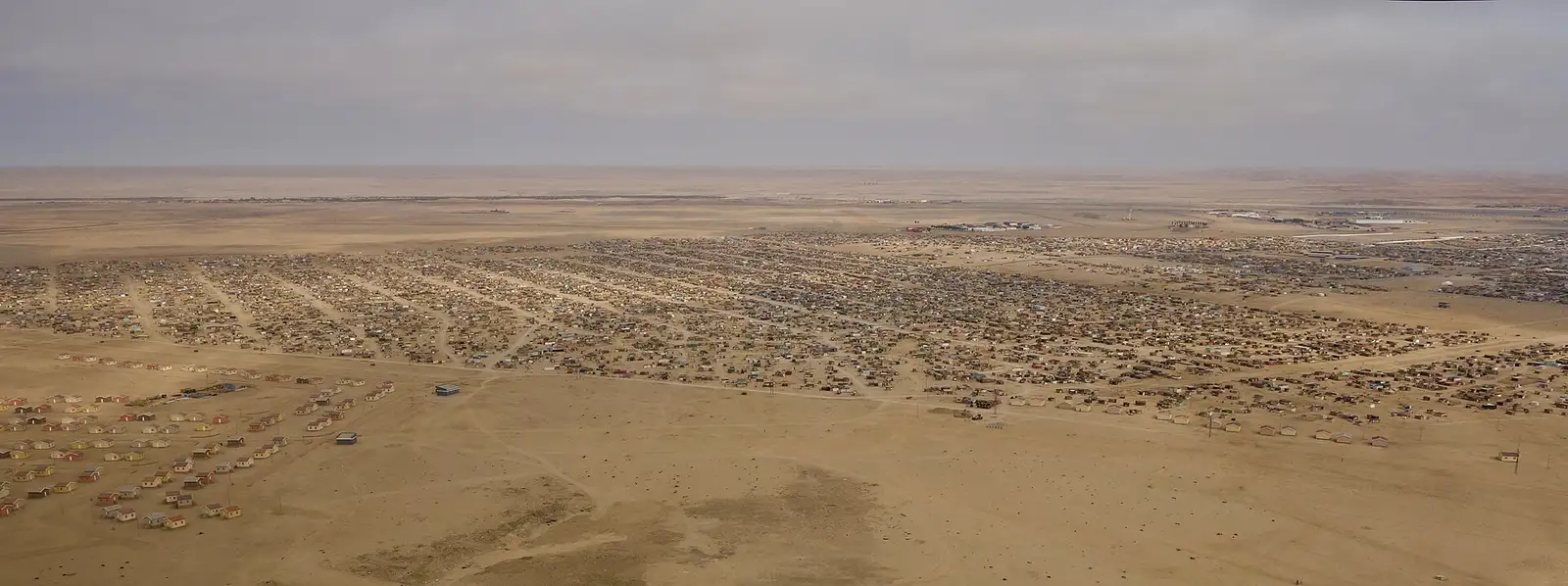
The DRC is an informal settlement next to Mondesa. It was set up around 2001 as a “temporary” resettlement area for people moving to Swakopmund for work and waiting for subsidised housing. Residents built shelters from corrugated iron, wood, canvas and plastic, many salvaged from the municipal landfill.
Instead of being temporary, the DRC kept growing. Estimates of its population range widely, from about 20,000 to over 40,000 people. Services have improved slowly, and some plots now have electricity and water, but many households still lack basic sanitation. The municipality has started issuing land ownership certificates to residents, and parts of the area have been formalised.
Seeing DRC can be uncomfortable, and it should prompt questions rather than photos. A good guide will explain the housing crisis, unemployment and the community’s own efforts, including kindergartens, soup kitchens and small businesses, without turning residents into a spectacle.
What to expect on a typical tour#
Most tours last 3–4 hours, with pick-up from your accommodation in Swakopmund. The exact route depends on the operator, but common elements include:
- An introduction to the history of segregation and the townships, often at a viewpoint or at the start of Mondesa.
- A walk or drive through Mondesa, including OB Street and a local market where you can try kapana, strips of beef grilled over open fires and eaten with spicy salsa.
- A visit to DRC, ideally on foot with your guide and with time to talk to residents, rather than viewed only through a vehicle window.
- A craft workshop or market, often with baskets, jewellery, recycled-material art and Herero dolls.
- A traditional meal, at a family home or at a township restaurant such as Hafeni Traditional Restaurant on Lucas Nehoya Street, typically mahangu (pearl millet) porridge, wild spinach, beans, “marathon” free-range chicken or, for the brave, mopane worms, with a home-brewed or soft drink.
- Cultural introductions, such as the four click sounds of Khoekhoegowab (the Damara/Nama language), Oshiwambo greetings, or the long Victorian-era-inspired dresses and horn-shaped headdresses worn by Herero women. Ask about the link between the Herero and the Himba of the far north-west: they speak the same language, Otjiherero, and a century ago dressed alike, but colonial history pushed the two peoples down very different paths.
- Sometimes music, such as a local choir, or a stop at a shebeen (neighbourhood bar).
Some tours also visit a kindergarten. If yours does, see our tips below on how to make this respectful.
Approximate prices (2026)#
| Option | Approx. price per person | Notes |
|---|---|---|
| Shared 3–4 hour tour with meal | N$1,000–N$1,500 | Pick-up and drop-off usually included |
| Private tour | N$1,500–N$2,500 | Depends on group size and duration |
| Booked via international platforms | Often 20–40% more | Convenient, but less money reaches the operator |
Online listings in 2026 show the best-known local operator’s tours at roughly US$62–US$80 per adult for 3–4 hours (about N$1,100–N$1,450 at current exchange rates). Booking directly with the operator or through your hostel is usually cheaper. Prices change, so confirm what is included (meal, drinks, donations) before you pay. For more on getting good value, see our Swakopmund tours and packages guide.
How to choose a responsible township tour#
Not every township tour is equal. Use these questions to choose:
- Who runs it? Prefer operators that are owned by, or employ, guides who grew up in Mondesa or DRC. They know the families, can open doors and are accountable to their neighbours.
- Where does the money go? Ask how much of the price goes to the host family, the craftspeople and any projects visited. A good operator will answer openly.
- How big is the group? Small groups, ideally under 10 people, are less intrusive. Avoid tours that move large groups by bus.
- Do you walk? Tours that include walking and conversation feel very different from drive-throughs.
- Is it a conversation? The best tours encourage questions both ways, and your hosts may be just as curious about where you come from.
- What do recent reviews say? Look for comments on punctuality, the guide’s knowledge and whether visitors felt welcomed rather than paraded.
Local operators#
One of the best-reviewed options is Explorer Tours (also listed as Nande Junias Explorer Tours or Explorer Cultural Township Tours). It is run by Nande Junias, who grew up in Mondesa, and offers 3–4 hour Mondesa and DRC tours with a local lunch, including a walk along OB Street, plus a bicycle version. The operator says a quarter of what you pay goes to the Mondesa community; ask how that works when you book. Reviews have been consistently positive. Other local guides and small operators offer similar tours, and your hostel or guesthouse can usually recommend someone they trust.
Questions worth asking on your tour#
Good guides enjoy questions, and asking them turns a tour into a conversation. A few that often lead to interesting answers:
- How has Mondesa changed since independence in 1990?
- What are the biggest challenges for people living in DRC today, and what is the community doing about them?
- Which languages do people speak at home here, and how do children learn English?
- How do people find work in Swakopmund, and how important are tourism, fishing and the uranium mines inland?
- What do local people think about the colonial-era monuments in the town centre?
- How do families celebrate weddings, funerals and holidays?
Be ready to answer questions about your own life too. Your hosts are often just as curious about you as you are about them.
Before you book: a quick checklist#
- The guide is from, or lives in, the community.
- The group size is small, and the tour includes time on foot.
- The price clearly states what is included, such as the meal, drinks and any donations.
- Pick-up time and place are confirmed in writing.
- Recent reviews mention respectful, conversational visits rather than photo stops.
Etiquette: how to be a good guest#
- Ask before photographing people, and accept a no. Never photograph children without a parent’s consent.
- Don’t photograph homes or people’s poverty as scenery. If you’d find the photo offensive of your own neighbourhood, don’t take it.
- Don’t hand out sweets, money or gifts. It encourages begging and can undermine schools and parents. If you want to give, ask your guide about a transparent community project.
- Kindergarten visits: Keep them short and quiet, don’t interrupt lessons, and don’t post identifiable photos of children online. If a donation is suggested, ask who receives it and how it is used.
- Dress modestly, with shoulders and knees covered, especially when visiting homes or churches.
- Accept food and drink graciously. Try a little of everything you’re offered; it is fine to politely decline alcohol.
- Buy crafts directly from the makers, at a fair price. Bargaining hard over a few dollars helps no one. Carry small notes, as most sellers do not take cards (see our Namibia money guide).
- Learn a greeting. Even a simple Oshiwambo greeting such as “Wa lalapo” (good morning) is warmly received.
Safety#
Mondesa is a normal, busy residential area, and on a guided tour you’ll be with someone who knows the neighbourhood. Leave expensive jewellery at home, keep your phone and camera secure, and follow your guide’s lead on where to walk. Don’t explore DRC on your own, both for safety and out of respect for residents’ privacy. For more general safety advice, see is Swakopmund safe? and is Namibia safe?
Combining your tour with other experiences#
- History walk: Do the self-guided history and architecture walk the same day for the full picture of colonial and apartheid-era Swakopmund.
- Swakopmund Genocide Museum: This small, privately run museum, founded in 2015 by activist Laidlaw Peringanda, focuses on the 1904–1908 genocide of the Ovaherero and Nama. Ask your guide whether it can be included.
- The Memorial Park in Kramersdorf: the former African Cemetery on the edge of town, where thousands of victims of Swakopmund’s concentration camps lie in unmarked graves that show only as low sand mounds. A guide can take you there and explain the site; see the extension in our history walk.
- Kapana for lunch: If your tour ends at midday, a kapana stop is one of the cheapest and most delicious meals in town. It is also on our list of free and cheap things to do in Swakopmund.
- Adventures: Township tours fit easily into an afternoon after a morning of sandboarding or a Living Desert tour; see our best things to do in Swakopmund.
Common mistakes#
- Booking the cheapest bus tour. Large-group drive-throughs give you little insight and give the community little benefit.
- Treating it as a photo safari. The point is people and conversation, not pictures.
- Bringing bags of sweets for children.
- Skipping the meal. The home-cooked lunch is often the highlight, and it is a direct income for the host family.
- Not asking questions. Guides generally welcome questions about politics, history, housing and daily life, so ask.
A township tour won’t fit everyone’s trip, but if you want to understand the town beyond the dunes and the cafés, it is one of the best-value half-days in Swakopmund. For more ideas, start with our Swakopmund travel guide.
Frequently asked questions
Are township tours in Swakopmund ethical?
They can be, if the tour is run or guided by people from the community, groups are small, residents are treated as hosts rather than attractions, and money stays local. Avoid tours that drive large groups through in a bus and photograph people's homes from the windows.
Is it safe to visit Mondesa?
On a guided tour, yes. Guides are known in the community and plan the route. Visiting the informal DRC settlement without a guide is not recommended, both for your safety and out of respect for residents' privacy.
How much does a Mondesa township tour cost?
Expect approx. N$1,000–N$1,500 per person in 2026 for a 3–4 hour tour with pick-up and a meal; international platforms list the main local operator at about US$62–US$80. Booking directly with the operator is usually cheaper than booking through those platforms.
What is DRC in Swakopmund?
DRC stands for Democratic Resettlement Community, an informal settlement on the edge of Mondesa set up around 2001 as a temporary area for people waiting for subsidised housing. It has since grown into a permanent home for tens of thousands of people.
Can I take photos on a township tour?
Yes, but always ask first, and accept a no. Photograph people only with their permission, don't photograph children without a parent's consent, and avoid photos that frame poverty as a spectacle.
Should I bring gifts for children?
No. Handing out sweets, money or pens encourages begging and can disrupt schools. If you want to give, ask your guide about a community project, kindergarten or school that accepts donations transparently.