Swakopmund’s headline activities, such as skydiving, quad biking and Sandwich Harbour tours, can quickly eat through a backpacker budget. The good news is that many of the town’s best experiences are free: sunset at the Mole, walking the historic jetty, climbing the dunes across the Swakop River, seeing flamingos on the Walvis Bay lagoon and exploring the colonial-era centre. Here are 20 free or nearly free ideas, with practical tips so you can mix them with one or two paid adventures.
Interactive
Swakopmund trip cost calculator
Pick your travel style, trip length and activities for a realistic price range.
Estimated total for your group
–
Indicative 2026 prices, excluding flights and getting to Swakopmund. Approximate rates for planning only; check a live converter before you travel.
Free things to do in Swakopmund town#
1. Watch sunset from the Mole#
The Mole, the stone breakwater built around 1900 to create a harbour (it silted up instead), is Swakopmund’s favourite sunset spot. Walk to the end of the rocks, watch the sun drop into the Atlantic, and look back at the town’s colourful skyline. Bring a jacket: it gets cold the moment the sun goes down.
2. Walk the jetty#
The historic jetty stretches about 262 m into the Atlantic. Closed as unsafe in 1998, it was rebuilt and reopened in August 2010, and walking along it is free at the time of writing. Go at sunset or on a windy day when the swells crash beneath your feet. You only pay if you stop for a drink at the restaurant at the end.
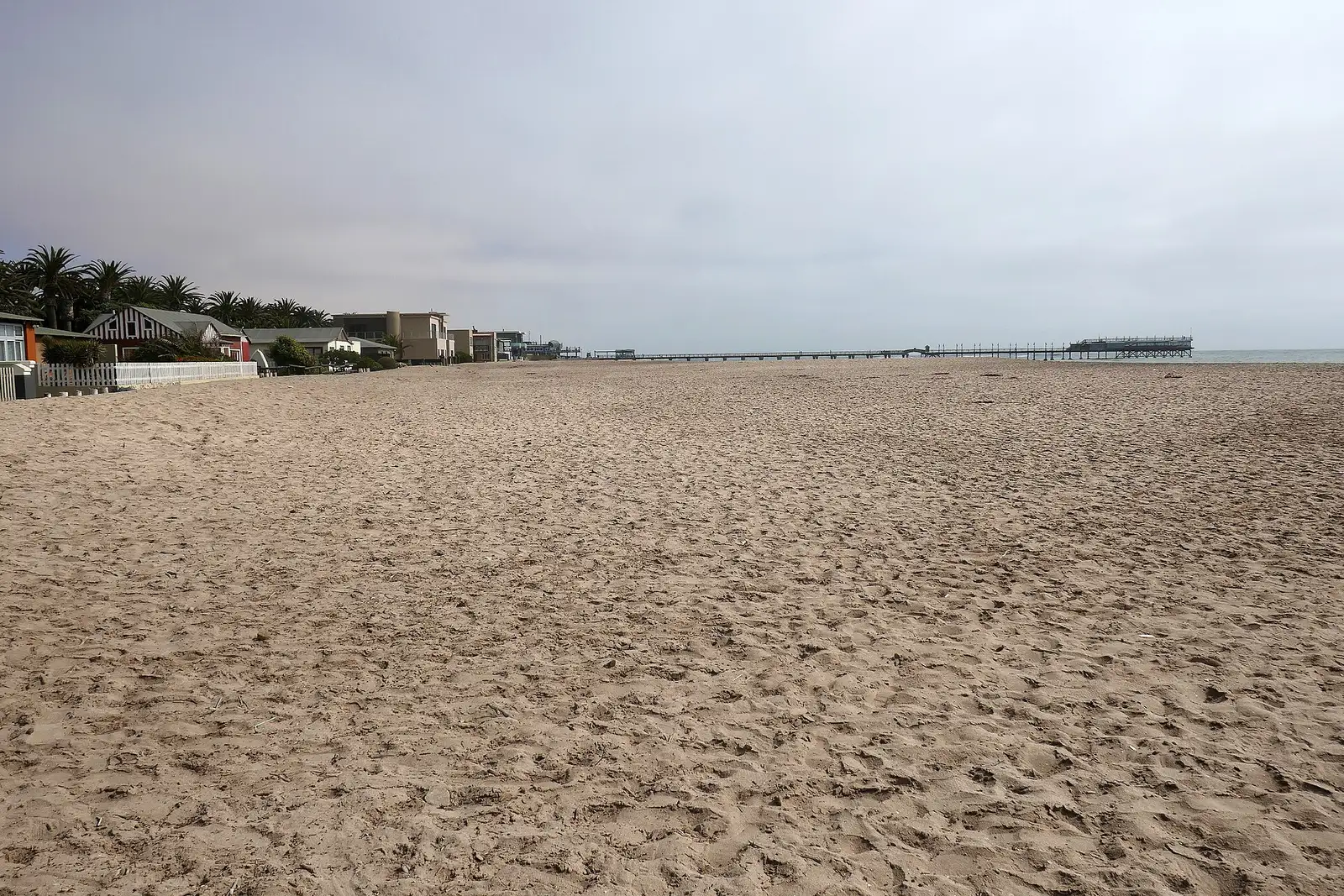
3. Follow the beach promenade#
A paved promenade runs along the seafront past the jetty, the Mole and Palm Beach. It is perfect for an early morning run, a long walk or watching fishermen and surfers. Keep going north past the Mole to quieter beaches for a longer walk; our Swakopmund beaches guide describes each stretch.
4. Take our self-guided history walk#
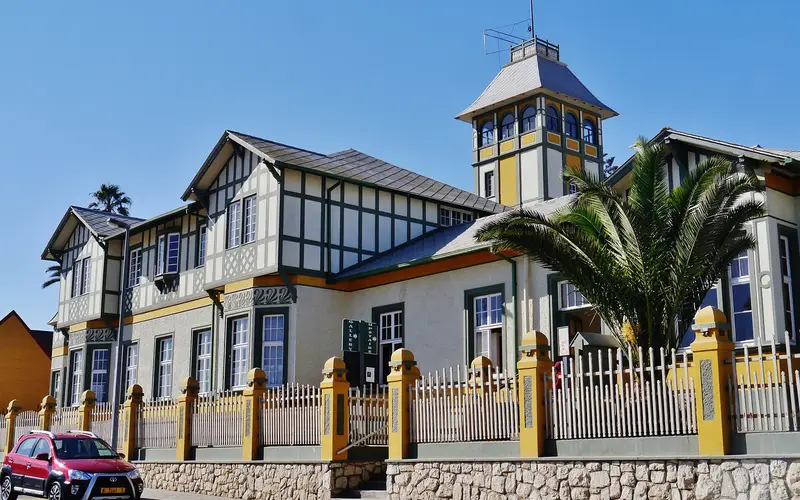
The old town is full of colonial-era buildings: Woermann House with its tower, the ornate Hohenzollern Building, the 1901 railway station (now a hotel) and the neo-baroque Lutheran church. Our free Swakopmund history and architecture walk puts 14 stops in a 2–3 hour loop and explains the history behind them, including the town’s role in the 1904–1908 genocide of the Ovaherero and Nama. Its optional extension, the Memorial Park in Kramersdorf where thousands of camp victims are buried, costs nothing to visit but deserves a quiet, respectful approach.
5. Swim (briefly) at Palm Beach#
The sheltered beach beside the Mole is the town’s safest swimming spot. The water is cold all year thanks to the Benguela Current, so most people manage a quick, bracing dip. On sunny afternoons it is a free, lively place to people-watch.
6. Browse the craft markets#
At the open-air craft market near the lighthouse, sellers display carvings, baskets, jewellery and Herero dolls. Browsing is free, and buying directly from makers means your money goes straight to them. Bargain politely, if at all, and don’t feel pressured to buy.
7. Wander the arcades and Tobias Hainyeko Street#
The Brauhaus Arcade and the streets around it are lined with cafés, bookshops, galleries and craft shops, including Tusk T-shirts, which has designed and screen-printed its shirts in Swakopmund since 1990. Window shopping costs nothing, and it is a good way to spend a foggy morning.
8. Visit Woermann House#
Woermann House, built in 1894 with its distinctive Damara Tower, is now a public library. Pop in during opening hours to see the courtyard and one of the town’s most important colonial buildings from the inside.
9. Look inside the old railway station#
The 1901 station building, now the Swakopmund Hotel and Entertainment Centre, is open to the public. Walk in to see the grand interior, and if you want, buy one drink to justify the visit.
10. Watch the birds at the Swakop River mouth#
Where the usually dry Swakop River meets the sea, on the southern edge of town, small lagoons attract flamingos, waders and other waterbirds, especially in the morning. Bring binoculars if you have them.
Free (or nearly free) things to do just outside town#
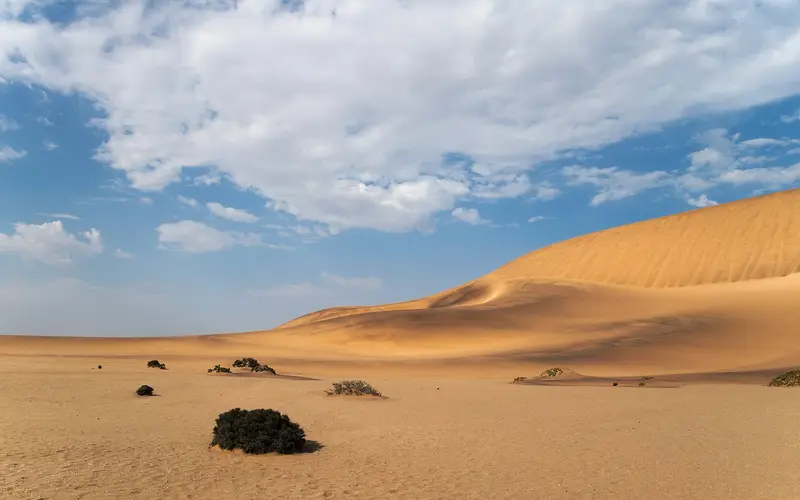
11. Climb the dunes south of the Swakop River#
You don’t need to pay for a tour to stand on a big dune. The dune belt starts just south of the Swakop River, about 2–4 km from the centre. Cross the riverbed on foot (or take a short taxi ride to the start), then climb for views over the town, the river valley and the Atlantic.
12. Run, walk or cycle to Long Beach#
Long Beach (Langstrand) is a quiet holiday settlement between Swakopmund and Walvis Bay, with a long, empty beach and dunes on the other side of the road. If you have a bike or a car, it makes a good half-day outing.
13. See the flamingos at Walvis Bay lagoon#
The Walvis Bay lagoon, about 35 km south, is one of the best free wildlife experiences in Namibia. Thousands of greater and lesser flamingos feed along the shoreline, often just a few metres from the lagoon promenade, alongside pelicans and waders. They tend to feed closest to the promenade when the tide is in, so check the tide times before you go. Share a car or take a minibus taxi to save money. Our Walvis Bay day trip guide has the details, and the Walvis Bay travel guide covers the rest of the town. If you have a 4x4 or join a tour, the drive out to Pelican Point adds seals and a lighthouse.
14. Watch skydivers and kite-surfers#
On clear days you’ll often see tandem skydivers and colourful canopies drifting down over the desert near the airfield, and kite-surfers on windy afternoons along the coast. It is a free show, and a good way to decide whether you want to try it yourself. If you do, see our skydiving in Swakopmund guide.
15. Drive the salt road north (if you have a car)#
The C34 coast road north of town passes Wlotzkasbaken’s quirky water-tank houses, lichen fields that come to life in the fog, and the Zeila shipwreck in the surf near Henties Bay. All of these stops are free; only Cape Cross charges entry. See our Skeleton Coast guide.
Cheap but worth paying for (under approx. N$100)#
16. Swakopmund Museum#
Near the lighthouse, the town’s main museum covers desert ecology, minerals, colonial history and, newly, the 1904–1908 genocide. Entry is approx. N$30–N$80 in 2026, one of the best-value hours in town.
17. Kristall Galerie#
Opened in 1998 in a crystal-shaped building at the corner of Tobias Hainyeko Street and Theo-Ben Gurirab Avenue, the Kristall Galerie displays a quartz cluster of more than 14 tonnes and about 3.5 m high, billed as the world’s largest, plus a replica tourmaline mine tunnel and a small garden studded with semi-precious stones. The entry fee is small, and the gemstone shop is free to browse. It is usually open Monday to Saturday, roughly 09:00–17:00, and closed on Sundays.
18. The Martin Luther steam engine#
Just outside town on the road to Windhoek stands the Martin Luther, a steam traction engine from around 1896 that was meant to haul freight across the desert and famously gave up within a few kilometres. Entry has historically been free or by small donation. It is a quick, quirky photo stop if you’re driving that way.
19. Eat kapana in Mondesa#
Kapana, strips of beef grilled over open fires and dipped in spicy salsa, is one of the cheapest and tastiest meals in Namibia, sold at informal markets in the townships. The easiest way to try it is on a guided Mondesa township tour; if you go alone, ask your hostel for advice and go during the day.
20. Coffee and cake as cheap entertainment#
When the fog rolls in, a coffee and slice of German-style cake in one of the town’s cafés costs approx. N$60–N$100 and buys you an hour of warmth, Wi-Fi and people-watching. See our top restaurants in Swakopmund for ideas.
Free things to do on a foggy day#
Fog is part of life in Swakopmund, especially in the mornings. Instead of waiting it out, use it:
- Go lichen-spotting on the salt road north (if you have a car). Fog is when the lichen fields come alive.
- Walk the beach and the jetty. The mist rolling over the surf is moody and photogenic, and you’ll have it almost to yourself.
- Read up at the library in Woermann House, or browse the bookshops in the arcades.
- Plan your next stage with free maps and advice from your hostel’s tour desk or the NWR office in town.
The fog usually burns off by late morning, so save the dunes and the Mole for the afternoon.
Things that are NOT free (so you can plan)#
- Dune 7 near Walvis Bay has charged an entry fee since December 2022 (approx. N$150 per international adult when introduced).
- Cape Cross Seal Reserve charges premium park fees: N$280 per foreign adult per day plus N$60 per car from 1 April 2026.
- The Moon Landscape and Welwitschia Drive need a park permit, available from the NWR office in Swakopmund. See our Moon Landscape and Welwitschia Drive guide.
- Sandwich Harbour is only reachable by 4x4 at low tide and is usually done as a paid tour.
- The National Marine Aquarium has been closed since October 2023 because seawater had corroded its concrete and steel, and repairs were still only being planned in 2025. Don’t plan on it unless you see news that it has reopened.
Backpacker budget tips for Swakopmund#
- Self-cater. Most hostels have shared kitchens, and supermarkets in the centre stock everything you need. Cooking dinner can halve your daily food costs. Bottle stores generally stop selling alcohol from about 13:00 on Saturday until Monday, so plan weekend braais ahead.
- Use cash for small things. Craft sellers, car guards (about N$10) and minibus taxis want small notes; see our Namibia money guide.
- Pick one or two big activities. Choose the adventure you really want (sandboarding is one of the cheaper options), then fill the rest of your time with the free ideas above.
- Share transport. Split a rental car or taxi to Walvis Bay, the Skeleton Coast or Spitzkoppe with people from your hostel.
- Ask about group and combo discounts. Hostels often have deals with local operators.
- Eat your big meal at lunch. Many restaurants have cheaper lunch menus than dinner menus.
- Visit outside peak season. Mid-December to mid-January is the busiest and priciest time. February to November is calmer and better value.
For daily budgets and more ways to save, see our Swakopmund budget travel guide, and for cheap places to stay, our Swakopmund backpackers and hostels guide.
A free day in Swakopmund: sample plan#
- 08:00: Early run or walk along the beach promenade.
- 09:30: Birdwatching at the Swakop River mouth, then climb the dunes across the river before the heat (and wind) build.
- 12:30: Self-catered lunch at your hostel.
- 14:00: Self-guided history walk through the old town, with a peek inside Woermann House and the old station.
- 16:30: Browse the craft market near the lighthouse.
- 18:00: Sunset from the Mole or the jetty.
- 19:30: Cook dinner with your hostel mates and plan tomorrow’s adventure.
Total cost: approx. N$0, plus whatever you spend on groceries. For a fuller plan, see our 3 days in Swakopmund itinerary.
Common mistakes#
- Walking into the dunes at midday without water. It gets hot on the sand even when town is cool and foggy.
- Walking the beach or riverbed alone after dark. Stick to busy, lit areas at night and take a taxi.
- Leaving valuables on the beach while you swim.
- Assuming the aquarium is open because older guidebooks list it.
- Paying for things you could see for free. For example, you’ll see flamingos on the Walvis Bay lagoon without a tour.
Swakopmund doesn’t have to be expensive. Mix a few of these free experiences with one standout adventure and you’ll get a great trip without blowing your budget. For more ideas, see our Swakopmund travel guide.
Photo gallery
Frequently asked questions
What can you do for free in Swakopmund?
Walk the beach promenade and the jetty, watch sunset from the Mole, explore the historic centre on a self-guided walk, climb the dunes south of the Swakop River, and see flamingos on the Walvis Bay lagoon. Browsing the craft markets and arcades is free too.
Is Swakopmund expensive for backpackers?
Accommodation and food are reasonable, but adventure activities are expensive by African standards. Self-catering and mixing free activities with one or two paid tours keeps a backpacker budget to approx. N$600–N$1,000 per day in 2026.
Can you walk to the dunes from Swakopmund?
Yes. The dune belt starts just south of the Swakop River, about 2–4 km from the town centre. Cross the riverbed, stay out of fenced or marked areas, and go early or late in the day with plenty of water.
Is the Swakopmund jetty free to visit?
Walking along the jetty has been free since its restoration, and at the time of writing there is no entry fee. You only pay if you eat or drink at the restaurant at the end.
Is Dune 7 free?
No. Dune 7 near Walvis Bay has charged an entry fee since December 2022, and international visitors were charged approx. N$150 per adult when the fee was introduced. The dunes south of the Swakop River are a free alternative.