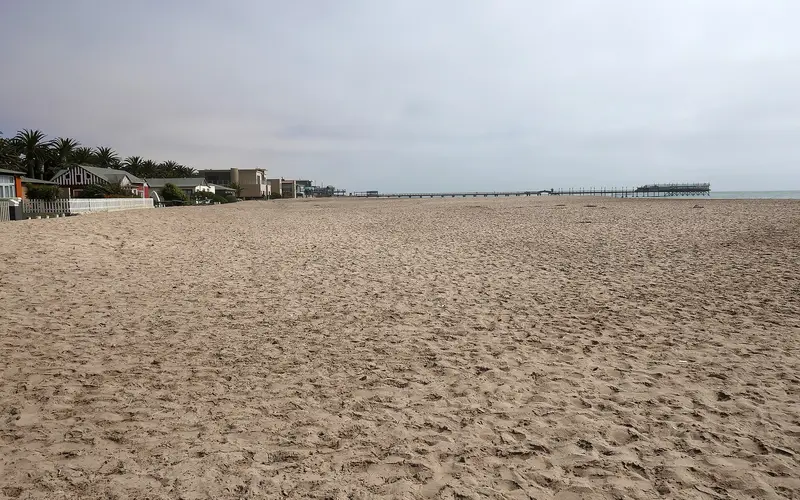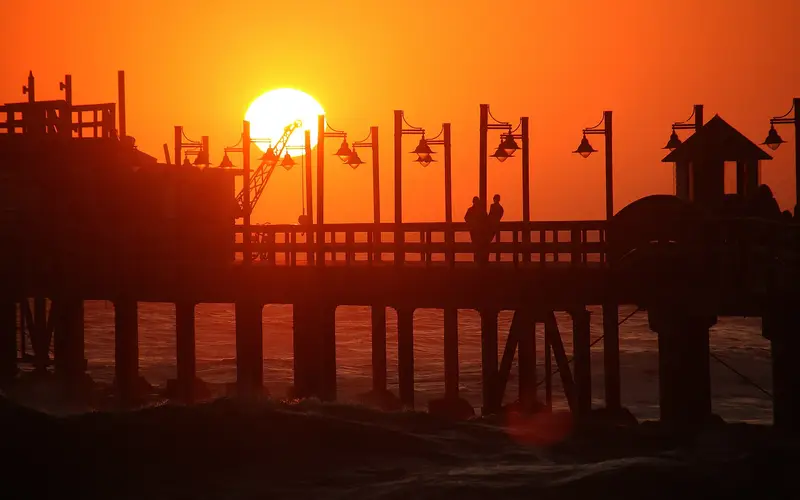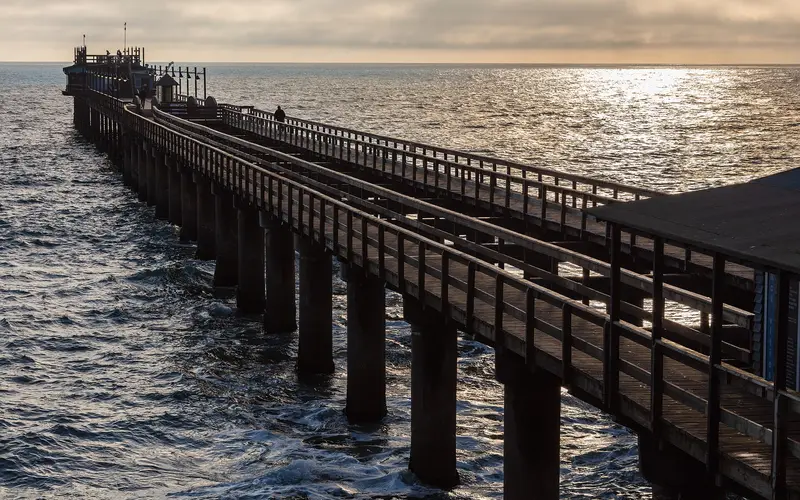
The best beach in Swakopmund for swimming is Palm Beach, the sheltered sweep of sand beside the Mole breakwater in the town centre. For walking and solitude, head north to Vineta and Mile 4, or south to Long Beach (Langstrand) and Dolphin Beach on the way to Walvis Bay. All beaches are free. The catch is the water: the cold Benguela Current keeps it at around 13–18°C most of the year, lifeguards are only on duty in the December–January holidays, and the open beaches have strong currents.
This guide covers each beach, what facilities to expect, how to stay safe in the water and when to go.
Live tide predictions
Walvis Bay & Sandwich Harbour tide times
Predicted high and low tides in Namibian time (CAT, UTC+2). Swakopmund is within a few minutes of these times.
Low-tide window (approx. ±2 h): when the Sandwich Harbour beach route is usually driven
Predictions are computed from long-term harmonic tidal constants and are not official navigation data. Wind, swell and air pressure can shift actual levels by 20–30 cm. Tour operators make the final call on Sandwich Harbour.
Tidal constants: TICON-4 (Hart-Davis, Dettmering & Seitz, 2025), CC BY 4.0, calibrated to Walvis Bay.
Interactive
Swakopmund weather, month by month
Tap a month to see what to expect. Temperatures are averages in °C.
Jan
- High / low
- 22° / 16°C
- Sea
- 17°C
- Rain
- 2 mm
- Sunshine
- 6 h/day
- Fog
- Frequent morning fog
Warm, busy local holiday season; expect grey mornings that usually brighten by midday.
Feb
- High / low
- 23° / 16°C
- Sea
- 18°C
- Rain
- 3 mm
- Sunshine
- 6 h/day
- Fog
- Frequent morning fog
The warmest month and the warmest sea of the year, but still a wetsuit-cold Atlantic.
Mar
- High / low
- 22° / 16°C
- Sea
- 17°C
- Rain
- 6 mm
- Sunshine
- 6 h/day
- Fog
- Some foggy mornings
The 'wettest' month, which still means only a few millimetres; quieter after the holidays.
Apr
- High / low
- 21° / 14°C
- Sea
- 16°C
- Rain
- 2 mm
- Sunshine
- 7 h/day
- Fog
- Some foggy mornings
Mild and settled; occasional hot east-wind days can push temperatures well above average.
May
- High / low
- 21° / 12°C
- Sea
- 15°C
- Rain
- 1 mm
- Sunshine
- 7 h/day
- Fog
- Mostly clear mornings
Often the clearest month, with crisp mornings and good visibility for scenic flights.
Jun
- High / low
- 20° / 11°C
- Sea
- 14°C
- Rain
- 1 mm
- Sunshine
- 7 h/day
- Fog
- Mostly clear mornings
Cool nights and sunny days; east winds can bring warm, dusty, sand-blown afternoons.
Jul
- High / low
- 20° / 10°C
- Sea
- 13°C
- Rain
- 0 mm
- Sunshine
- 7 h/day
- Fog
- Mostly clear mornings
Peak international travel season; pack a warm jacket for evenings around 10°C.
Aug
- High / low
- 18° / 10°C
- Sea
- 13°C
- Rain
- 0 mm
- Sunshine
- 7 h/day
- Fog
- Some foggy mornings
One of the coolest months; windy afternoons are common, so bring a windproof layer.
Sep
- High / low
- 18° / 11°C
- Sea
- 13°C
- Rain
- 1 mm
- Sunshine
- 6 h/day
- Fog
- Frequent morning fog
Cool and often foggy in the mornings; the coldest sea of the year.
Oct
- High / low
- 19° / 12°C
- Sea
- 13°C
- Rain
- 0 mm
- Sunshine
- 7 h/day
- Fog
- Some foggy mornings
Warming up with long days; a good shoulder month before the December rush.
Nov
- High / low
- 20° / 14°C
- Sea
- 14°C
- Rain
- 1 mm
- Sunshine
- 7 h/day
- Fog
- Some foggy mornings
Pleasant and fairly quiet, and a cool escape from the inland heat building at Sossusvlei.
Dec
- High / low
- 22° / 15°C
- Sea
- 16°C
- Rain
- 1 mm
- Sunshine
- 7 h/day
- Fog
- Some foggy mornings
Festive season: the town fills with Namibian holidaymakers, so book beds early.
View as table
| Month | High °C | Low °C | Sea °C | Rain mm | Fog |
|---|---|---|---|---|---|
| Jan | 22 | 16 | 17 | 2 | Frequent morning fog |
| Feb | 23 | 16 | 18 | 3 | Frequent morning fog |
| Mar | 22 | 16 | 17 | 6 | Some foggy mornings |
| Apr | 21 | 14 | 16 | 2 | Some foggy mornings |
| May | 21 | 12 | 15 | 1 | Mostly clear mornings |
| Jun | 20 | 11 | 14 | 1 | Mostly clear mornings |
| Jul | 20 | 10 | 13 | 0 | Mostly clear mornings |
| Aug | 18 | 10 | 13 | 0 | Some foggy mornings |
| Sep | 18 | 11 | 13 | 1 | Frequent morning fog |
| Oct | 19 | 12 | 13 | 0 | Some foggy mornings |
| Nov | 20 | 14 | 14 | 1 | Some foggy mornings |
| Dec | 22 | 15 | 16 | 1 | Some foggy mornings |
Source: weather2travel.com Swakopmund climate guide (long-term averages from CRU/University of East Anglia, UK Met Office and KNMI); fog rating is a qualitative seasonal guide to coastal fog and low cloud based on FogNet research. Long-term averages; individual days vary, especially during warm east-wind spells in autumn and winter.
Swakopmund beaches at a glance#
| Beach | Where | Best for | Swimming |
|---|---|---|---|
| Palm Beach / Mole Beach | Town centre, beside the Mole | Swimming, families, sunsets | Best in town; seasonal lifeguards |
| Jetty and lighthouse beach | South of the Mole to the jetty | Promenade walks, jetty sunsets | Paddling only; waves and currents |
| South beach / Swakop River mouth | South end of town | Birds, beach bar, dunes across the river | Not recommended |
| Vineta and Vogelstrand | Northern suburbs, approx. 3–5 km | Long walks, surfing, sea-view stays | Not recommended |
| Mile 4 | approx. 7 km north | Angling, salt pans, birds | No |
| Long Beach (Langstrand) | approx. halfway to Walvis Bay | Quiet holiday beach, dunes across the road | Calm days only, with care |
| Dolphin Beach | Just north of Walvis Bay | Holiday homes, beach walks | Calm days only, with care |
Palm Beach and the Mole#
Palm Beach is Swakopmund’s town beach and the one most visitors mean when they say “Swakopmund beach”. It lies in the bay sheltered by the Mole, a stone breakwater completed in 1903 for a harbour that quickly silted up. The failed harbour turned into the town’s most popular beach.
- What it is like: a curve of golden sand with a promenade, lawns and the palm trees that give the beach its name. Waves are gentler here than on the open coast.
- Swimming: the best spot in town for a dip, and where the holiday lifeguards are stationed.
- Facilities: benches, the promenade and plenty of cafés, restaurants and hotels within a few minutes’ walk, including the Strand Hotel on the Mole itself. Facilities such as toilets and showers vary, so do not count on them.
- Sunsets: walk out onto the Mole or the rocks at its end at sunset. It is one of the best free shows in town; see our free things to do for more.
The jetty and lighthouse beach#
South of the Mole, the beach continues past the lighthouse and the museum to the historic jetty, with the paved promenade running alongside. This is more a walking and people-watching beach than a swimming one, as the waves are bigger and the currents stronger than in the Mole’s shelter.
- Walk the jetty: the restored jetty stretches about 260 m out to sea, with a restaurant and oyster bar at the end. Walking out is free.
- Watch the surfers: you will often see surfers in the waves around the jetty and the Mole.
- Do not jump from the jetty. The water is cold, the swell surges around the pylons, and people have been badly hurt.
Our best things to do in Swakopmund covers the sights along this stretch.
South beach and the Swakop River mouth#
At the southern end of town, the beach runs to the mouth of the usually dry Swakop River. It is a broad, windswept stretch with a few attractions:
- Tiger Reef Beach Bar & Grill: a casual beach bar on the sand near the river mouth, with burgers, fish and chips and cold beers. It can get windy, so bring a jacket.
- Birdwatching: when there is water or damp ground at the river mouth, it attracts flamingos, pelicans, gulls and waders.
- Dunes: the dune belt begins just across the river and is free to climb. Most sandboarding and quad biking happen a little further south and east.
Do not swim here. The open beach has strong currents, and the river mouth can create unpredictable rips.
Vineta, Vogelstrand and the northern beaches#
North of the Mole, the town gives way to the residential suburbs of Vineta and Vogelstrand, fronted by kilometres of open beach.
- Best for: long beach walks, morning runs, kite-watching and surfing. The beaches are rarely crowded.
- Where to stay: several guesthouses, holiday flats and a backpackers’ lodge in Vineta look out over the sea. See our self-catering and Airbnb guide.
- Eating: a handful of beachfront restaurants, including a hotel restaurant with ocean views at Beach Lodge in Vogelstrand. See our restaurants guide.
- Swimming: not recommended. The open surf is powerful, with rips. Paddle only in calm conditions and stay in your depth.
Mile 4 and beyond#
About 7 km north of the centre along the C34, the coast around Mile 4 is wilder. The salt pans inland attract flamingos and cormorants, and the beach is lined with anglers. Facilities are limited, so bring what you need.
Further north, the C34 passes Wlotzkasbaken, numbered angling spots and the Zeila shipwreck on the way to Henties Bay and Cape Cross. These are beaches for looking at, fishing from and photographing, not for swimming. Our Skeleton Coast guide covers the route.
Long Beach (Langstrand)#
Long Beach, or Langstrand in Afrikaans, is a small holiday settlement roughly halfway between Swakopmund and Walvis Bay on the B2, with dunes rising directly across the road from the sea.
- What it is like: a long, quiet beach backed by holiday apartments and houses. Weekdays outside the holidays can feel almost deserted.
- Activities: beach walks, angling and, across the road, the dune belt used by quad and sandboarding operators. Some adventure operators are based along the B2 here.
- Where to stay: mostly self-catering holiday flats, ideal if you have a car.
- Downside: there is little within walking distance, so you need your own transport.
Dolphin Beach#
Just north of Walvis Bay, Dolphin Beach is a residential and holiday area with homes and a resort facing the sea. It is a good spot for a beach walk if you are based in Walvis Bay, and it is close to the lagoon, the flamingos and the Waterfront. See our Walvis Bay travel guide for everything nearby.
Water temperature: how cold is it?#
The Benguela Current brings cold, nutrient-rich water up from the south, which is why the coast has so much marine life and so much fog. It also means chilly swimming.
| Months | Typical sea temperature |
|---|---|
| December–March | approx. 15–20°C; warmest in late summer |
| April–May | approx. 14–18°C |
| June–November | approx. 12–16°C |
These are rough ranges. Upwelling can drop the temperature by several degrees overnight, even in summer. The interactive climate chart on this page shows monthly averages, and our weather and best time to visit guide has more detail.
Swimming safety#
Drownings happen on the Namibian coast every year, often during the busy December holidays. Lifeguards say the biggest risk factors are unsupervised children and swimming after drinking alcohol.
- Swim at Palm Beach, ideally when the seasonal lifeguards are on duty (around December–January).
- Stay in your depth and never swim alone.
- Watch for rip currents: darker, calmer channels between breaking waves. If caught, swim parallel to the beach, then back in.
- Keep children within arm’s reach, even in the shallows.
- Do not swim after drinking. Cold water and alcohol are a dangerous mix.
- Do not jump from the jetty or the Mole rocks.
- Do not try heroic rescues if you are not trained. Raise the alarm, throw something that floats and call for help.
Emergency numbers: the police emergency line is 10111. Swakopmund municipality also operates a toll-free 24-hour emergency line (1411 at the time of writing). Save both in your phone.
For general safety advice, see our Swakopmund safety guide.
Best time to go to the beach#
- Time of day: late morning to mid-afternoon. Mornings are often foggy and cool, and the wind usually picks up in the afternoon.
- Season: December to March is warmest and busiest. Autumn (around April–May) often brings the clearest days. Occasional east-wind days, mostly from about April to July, make the beach hot and sandy.
- Sunsets: spectacular all year from the Mole and the jetty.
What to bring#
- A windproof jacket or warm layer. It can feel cold even on sunny days.
- Sunscreen and a hat. The UV is strong, even through fog.
- A beach towel and a change of clothes.
- Water shoes for rocky areas and rock pools.
- A wetsuit if you want to stay in longer than a few minutes.
- Minimal valuables. Leave passports and expensive items at your accommodation.
Our full Swakopmund packing list covers the rest.
Beach activities#
- Surfing: lessons for beginners are available in Swakopmund, and experts head to Skeleton Bay.
- Angling: popular along the northern beaches, Mile 4 and Long Beach. You need a recreational angling licence.
- Kitesurfing: a regular sight on windy afternoons along the coast and on the Walvis Bay lagoon.
- Beach walks and runs: the promenade from the jetty to the Mole and beyond is perfect.
- Birdwatching: the Swakop River mouth, the Mile 4 salt pans and, best of all, the Walvis Bay lagoon.
Common mistakes#
- Expecting tropical water. It is cold all year.
- Swimming on open beaches when the surf is up. Stick to Palm Beach.
- Leaving bags unattended while you swim.
- Arriving at 08:00 expecting sunshine. Morning fog is normal.
- Walking empty beaches alone after dark.
- Driving on beaches outside designated areas. It is restricted on much of the coast.
For more ideas in town, see our Swakopmund travel guide.
Photo gallery
Frequently asked questions
Can you swim at Swakopmund beach?
Yes, but the water is cold and the open beaches have strong currents. Palm Beach, sheltered by the Mole breakwater, is the safest place for a dip. Swim near other people, stay in your depth and avoid the open beaches when the surf is up.
How cold is the sea in Swakopmund?
Usually around 13–18°C, thanks to the cold Benguela Current. Late summer (about January to March) brings the warmest water, occasionally around 20°C. Most people manage a quick, bracing swim rather than a long one.
What is the best beach in Swakopmund?
Palm Beach next to the Mole is the best all-round beach: sheltered, central and close to cafés. For long walks and solitude, head to Vineta and the northern beaches or to Long Beach (Langstrand) towards Walvis Bay.
Are there lifeguards on Swakopmund beaches?
Only seasonally. The municipality has contracted lifeguards for the Mole beach during the December–January holiday period, but there is no year-round lifeguard service. Outside that window you are on your own.
Is it safe to walk on Swakopmund beaches?
During the day, yes, especially near the centre. Do not leave bags unattended while you swim, and avoid walking on empty stretches of beach or along the riverbed alone after dark.
Are there sharks in Swakopmund?
Bronze whaler sharks live along the coast, but attacks on swimmers and surfers in Namibia are virtually unheard of. Cold water, currents and waves are the real risks.