Skeleton Bay is a sand-bottomed left-hand barrel on the sand spit near Pelican Point, just outside Walvis Bay. On a perfect swell it can run for around 2 km, with rides lasting well over a minute. It is one of the most famous waves in the world, and it is strictly for advanced and expert surfers. The best season is roughly May to August, the water is about 12–17°C, and access is by 4x4 over sand. If you are a beginner or intermediate, the beach breaks around Swakopmund offer lessons and friendly waves instead.
This guide explains how the wave works, when to go, how to get there, the real dangers, and the gentler surf options nearby.
Live tide predictions
Walvis Bay & Sandwich Harbour tide times
Predicted high and low tides in Namibian time (CAT, UTC+2). Swakopmund is within a few minutes of these times.
Low-tide window (approx. ±2 h): when the Sandwich Harbour beach route is usually driven
Predictions are computed from long-term harmonic tidal constants and are not official navigation data. Wind, swell and air pressure can shift actual levels by 20–30 cm. Tour operators make the final call on Sandwich Harbour.
Tidal constants: TICON-4 (Hart-Davis, Dettmering & Seitz, 2025), CC BY 4.0, calibrated to Walvis Bay.
What is Skeleton Bay?#
Skeleton Bay, also known locally as Donkey Bay, is not a reef or a rocky point. It is a long, shallow sandbank on the ocean side of the spit around Pelican Point, which protects Walvis Bay’s harbour. When a big, long-period swell from the south-west hits the sandbank at the right angle, it peels down the spit as a fast, hollow left.
A few things make it unique:
- Length. On the best days the wave can be ridden for a couple of kilometres, and surfers report single rides of well over a minute, some much longer. It is widely described as the longest sand-bottomed left in the world.
- Barrels. The wave is famous for long, mechanical tubes, sometimes compared to the heaviest waves on the planet.
- It is young and changeable. Local surfers say the sandbank only started producing this quality of wave in the early 2000s. It came to global attention around 2008, when it surfaced in a surf magazine’s Google Earth challenge. The shape of the bank keeps changing, and nobody knows how long it will last.
Setting: the wave breaks in front of empty desert, with seals in the water, jackals on the beach and the fog rolling in off the cold Benguela Current. It is wild, and that is part of the appeal and the danger.
Who should surf Skeleton Bay?#
Experts only. Be honest about your level:
| Your level | Should you paddle out? |
|---|---|
| Beginner | No. Take lessons near Swakopmund instead |
| Intermediate (catching green waves, basic turns) | No on a real swell; watch from the beach |
| Advanced (comfortable in hollow, powerful beach breaks) | Possibly on smaller days, ideally with a local guide |
| Expert (regular barrel rider, high surf fitness) | Yes, with preparation and a partner |
Why the caution:
- Speed and power. The wave is fast and throws hard. Wipeouts drive you into shallow sand.
- Shallow sand bottom. Hitting the bank is the most common cause of injury here.
- The current. A strong current sweeps down the point, and on many days it is impossible to paddle against. You ride, get out, and walk back.
- No rescue services. There are no lifeguards or sea rescue services at Skeleton Bay. Help is far away, and the nearest hospitals are in Walvis Bay.
- Fog. Thick fog can roll in and hide the beach from the line-up, which is dangerous when a rip can carry you hundreds of metres in minutes.
Best season, swell and conditions#
Season#
The main season is roughly May to August, the southern winter, when deep low-pressure systems in the South Atlantic produce powerful long-period swells headed for Namibia. June is often singled out as the most reliable month. Outside these months the wave can still break on rare swells, and local guides talk about the occasional surprise at Christmas, but do not plan a trip on luck.
Even in season, Skeleton Bay only fires properly on a limited number of days a year. Serious surfers set swell alerts and book flights at short notice when a good forecast appears.
Swell and wind#
- Swell direction: south-west.
- Swell size and period: the wave needs a sizeable, long-period groundswell to wrap into the bank. Small, short-period swells produce little or nothing.
- Wind: mornings on the Namibian coast are often calm or light; the wind typically rises from late morning. Surf forecasters disagree on the ideal wind direction here, so ask a local guide how the forecast is likely to translate on the day.
- Tide: many surfers say the wave is at its longest and fastest around lower tides, but it can work at different stages. Check the tide table on this page and our tide times guide when planning sessions and the drive along the spit.
How to get to Skeleton Bay#
Getting to the coast#
- Fly into Walvis Bay (WVB): the closest airport, with flights from Johannesburg and Cape Town. It is about 15 km east of Walvis Bay. See our Walvis Bay travel guide.
- Fly into Windhoek: then drive about 4.5 hours to the coast. See Windhoek to Swakopmund.
- Where to stay: Swakopmund has more surf-friendly accommodation, including a surf hostel; Walvis Bay is a little closer to the wave. Our backpackers and hostels guide lists budget options.
Getting to the wave#
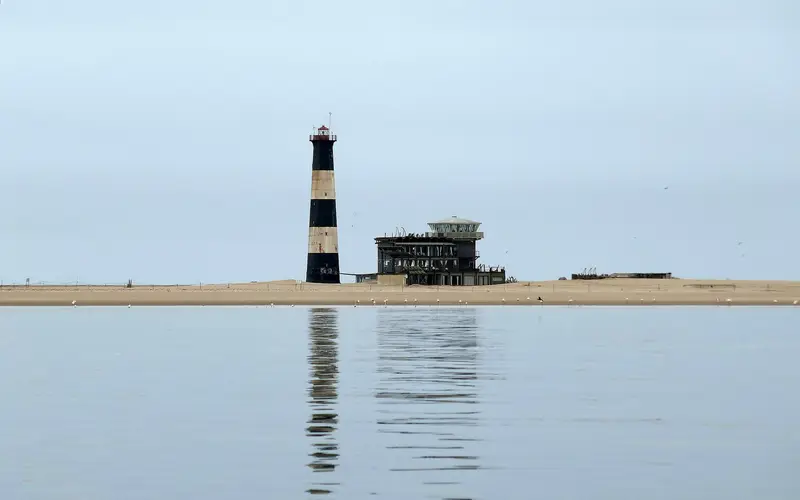
From Walvis Bay, the route runs past the lagoon and salt works and onto sand tracks across salt flats towards the spit. Our Pelican Point guide describes the terrain in detail.
- You need a proper 4x4 with low range, deflated tyres and recovery gear. Salt flats that look hard can be soft and wet underneath.
- Check your insurance. Standard rental cover usually excludes beach and off-road driving. See our car rental guide.
- Respect local etiquette. Surfers walk back up the point after each wave, which can take 15–25 minutes; driving back up the beach to the peak is frowned upon, and there are reports of a local “no 4x4 back to the peak” rule. Park where others park.
- Never park below the high-tide line, and keep vehicles clear of the beach on big swells.
Permits and rules#
At the time of writing, we found no surf-specific permit for Skeleton Bay. The spit lies within Dorob National Park, however, and off-road driving in the park is restricted to designated tracks and areas. Rules can change, so check with the Ministry of Environment, Forestry and Tourism (MEFT) office in Walvis Bay or Swakopmund, or ask a licensed local guide, before you drive out.
Going with a guide#
The easiest way to surf Skeleton Bay as a visitor is with a local guide who knows the forecast, the tracks and the bank.
- Salty Jackal in Swakopmund runs Skeleton Bay “strike missions” for advanced and elite surfers, including forecast consultation and daily 4x4 guiding to the wave. In 2026 it lists approx. N$2,000 per person per day, with a minimum of three people, and can arrange pick-ups from Walvis Bay airport, accommodation and surf photography.
- Some guesthouses in Walvis Bay also help arrange surf transport. Ask when you book.
Crowds and etiquette#
When the forecast is right, Skeleton Bay attracts surfers from all over the world, and local guides report anything from dozens to more than 200 people at the spot on the best swells. The conveyor-belt current spreads the crowd out, and most people still get waves.
- Say hello and wait your turn. Namibia’s surf community is small and friendly, and visitors are noticed.
- Do not paddle back against the current. Get out and walk.
- Take your rubbish home and leave the wildlife alone. Jackals will investigate unattended bags and food.
Safety and gear#
Wetsuits and water temperature#
| Months | Sea temperature (approx.) | Suggested wetsuit |
|---|---|---|
| December–February | 17–22°C | 3/2 or 4/3 mm |
| March–April | 14–18°C | 4/3 mm |
| May–August (Skeleton Bay season) | 12–17°C | 4/3 mm, boots, optional hood |
| September–November | 12–17°C | 4/3 mm |
Air temperatures in the surf season are often only about 10–20°C, with damp fog. Bring a warm change of clothes, a flask of something hot and a windproof jacket for the walk back up the beach.
Gear checklist#
- Boards: take strong boards and a spare. Snapped boards are common.
- Wetsuit: 4/3 mm minimum, plus boots and a hood for long sessions.
- Leash: a strong one, plus a spare.
- First-aid kit, including something for sand abrasions.
- Sunscreen: UV is strong even through fog.
- Water and food for an all-day session.
Safety rules#
- Never surf alone. Go with a partner or guide, and tell someone on land your plan.
- Know your limits. Watch for at least half an hour before paddling out.
- Watch the fog. If it rolls in thick, come in.
- Plan for emergencies. Mobile reception can be patchy and help is far away.
- Respect the cold. Hypothermia creeps up on long sessions.
What about sharks? Bronze whaler sharks live along the Namibian coast, but local surf operators point out that Namibia has no recorded shark attacks on surfers. The bigger risks are the bottom, the current, the cold and the isolation.
Not ready for Skeleton Bay? Surfing near Swakopmund#
The good news is that the rest of the coast has waves for every level, and the line-ups are usually close to empty. Swakopmund locals surf beach breaks, reefs and points in and around town, and many days have a morning window of light winds before the onshore breeze picks up.
Surf lessons and guiding#
Salty Jackal Surf School in Swakopmund has ISA-qualified, first-aid-trained instructors and includes boards, wetsuits and transport. Approx. 2026 rates:
| Option | Price (approx.) |
|---|---|
| Group lesson (3 hours incl. transfer) | N$950 per person |
| Private group lesson | N$1,300 per person |
| One-on-one lesson | N$2,400 |
| Guided half-day surf, group (intermediate and up) | N$950 per person |
| Board and wetsuit rental, half day | N$600 per set |
| Board and wetsuit rental, 24 hours | N$840 per set |
It also runs week-long surf camps for beginners to advanced surfers. Prices change, so confirm when booking.
Where beginners surf#
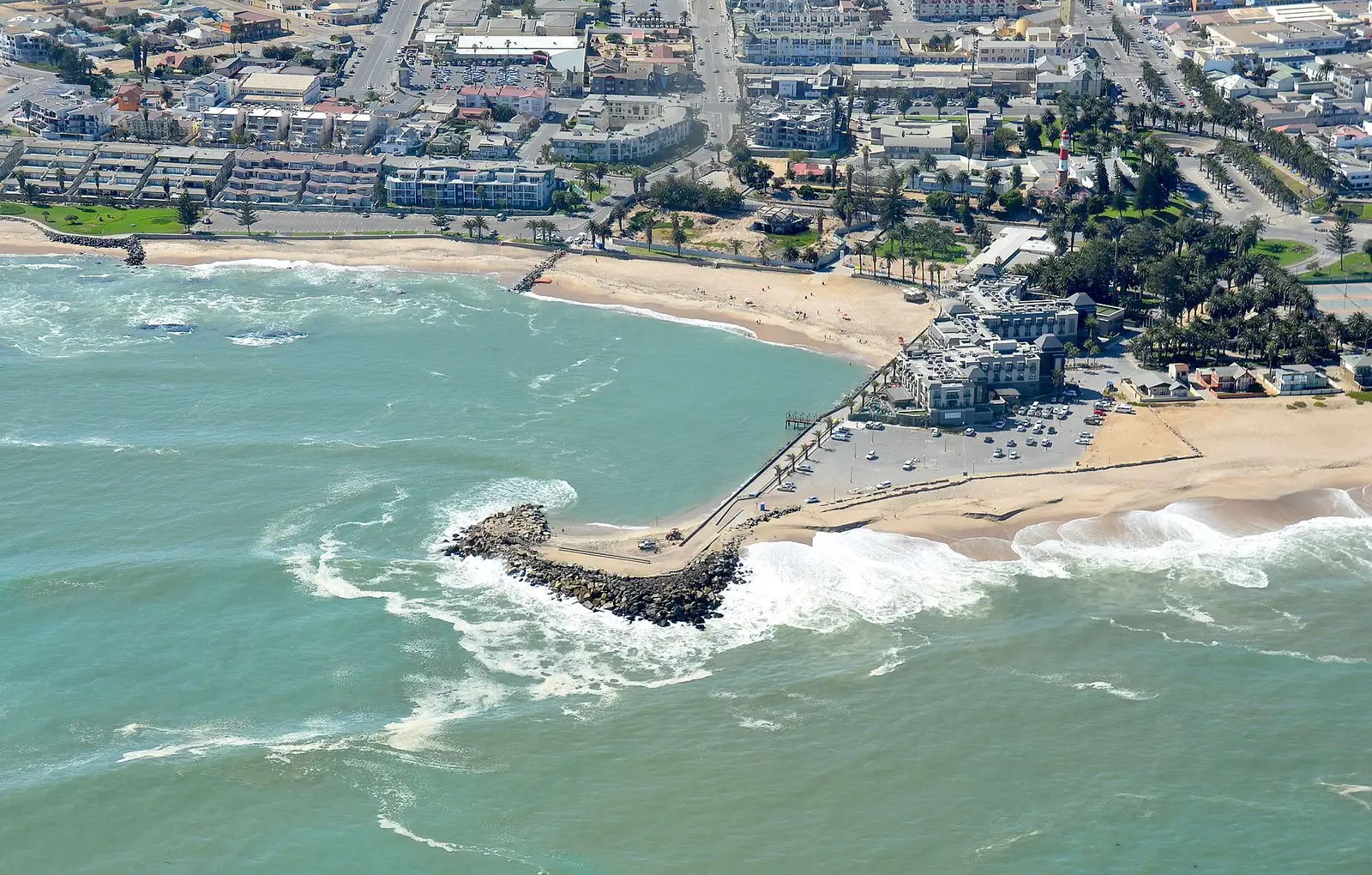
Instructors choose the beach depending on the swell, wind and tide, usually somewhere with gentle whitewater and a sandy bottom close to town. You will often see surfers around the Mole and along the northern beaches. See our Swakopmund beaches guide for an overview of the beaches and swimming safety.
Why not Walvis Bay?#
Walvis Bay sits inside a sheltered bay and lagoon, so there are no waves in town. The nearest surf is out on the spit, which is why most surfers base themselves in Swakopmund.
More adventures on the coast#
Between surf sessions, the coast has plenty more to keep you busy: sandboarding, skydiving, seal kayaking at Pelican Point and the dunes of Sandwich Harbour. Our adventure activities guide has the full list.
Photo gallery
Frequently asked questions
Where is Skeleton Bay?
On the sand spit around Pelican Point, just outside Walvis Bay on Namibia's central coast. Locals often call the area Donkey Bay. It is roughly an hour's drive from Swakopmund, the last stretch over sand by 4x4.
When is the best time to surf Skeleton Bay?
The main season is roughly May to August, when deep South Atlantic storms send long-period south-westerly groundswell to Namibia. Even then it only fires on a limited number of days a year, so serious surfers watch the forecast and travel at short notice.
Can beginners surf Skeleton Bay?
No. It is a fast, heavy, shallow wave with a powerful current and no lifeguards. Beginners and intermediates should learn and surf at the beach breaks around Swakopmund with a qualified instructor.
How cold is the water at Skeleton Bay?
Usually around 12–17°C during the winter surf season. A 4/3 mm wetsuit is the minimum, and many surfers add boots and a hood, especially on long sessions.
Do you need a permit to surf Skeleton Bay?
We found no surf-specific permit at the time of writing. However, the spit is in Dorob National Park, where off-road driving is restricted, so stay on established tracks and check the current rules with MEFT or a local surf guide before you go.
Are there sharks at Skeleton Bay?
Namibian surf operators point out that there are no recorded shark attacks on surfers in Namibia, although bronze whaler sharks live in these waters. The real dangers are the sand bottom, the current, the cold and the remoteness.
Where can I learn to surf near Swakopmund?
Salty Jackal runs a surf school and surf camp in Swakopmund with ISA-qualified instructors, gear and transport to beginner-friendly beaches. Group lessons cost approx. N$950 per person for a three-hour session in 2026.